
Search for patent types in India and you will be told there are three: utility, design and plant. That answer is wrong. Those are American categories, and none of them appears in the Indian statute book.
The confusion is costly. Inventors file the wrong form, miss a deadline that cannot be extended, or spend months chasing a right that does not exist here.
India crossed one lakh patent applications for the first time in 2024–25. Most came from Indian residents, and many from first-time filers. At Legismith LLP, we explain below what the Patents Act, 1970 actually offers you.
Patent Types in India: The Short Answer
Indian law gives you two sensible ways to group patents. Neither one matches the American list.
- By what is protected: product patents and process patents.
- By how you file: seven application routes, each with its own section and deadline.
The second grouping is what most people are really looking for. We cover both below.
Why Utility, Design and Plant Patents Do Not Apply Here
Those three terms come from United States law. Here is where each one actually lands in India.
American term | Position in India | Governing law |
Utility patent | Simply a patent. Every Indian patent is one. | The Patents Act, 1970 |
Design patent | Not a patent. It is a registered design. | The Designs Act, 2000 |
Plant patent | Does not exist. Section 3(j) excludes plants. | The PPV&FR Act, 2001 |
Provisional patent | Not a patent. It is a type of specification. | Section 9, Patents Act, 1970 |
If your product’s appearance is what matters, look at industrial design registration instead. If you have developed a new crop variety, that goes to the Protection of Plant Varieties and Farmers’ Rights Authority, not the Patent Office.
Secure Your Patent in India.
Learn about the statutory requirements and process for patent filing. Navigate complex legal frameworks with architectural precision and transparency.
Product Patents and Process Patents Explained
Section 2(1)(j) defines an invention as a new product or process. That single phrase is the only subject-matter split the Act recognises.
- Product patent — covers the thing itself. A new battery cell, a drug molecule, a device.
- Process patent — covers the method. A new way to make cement, or to synthesise a compound.
Section 48 gives a process patent extra reach. It protects the process and any product obtained directly from it.
This distinction is not academic. Until 2005, India granted no product patents for medicines or food — only processes qualified. India’s generic pharmaceutical industry grew inside that gap.
What Are the Types of Patent Applications in India?
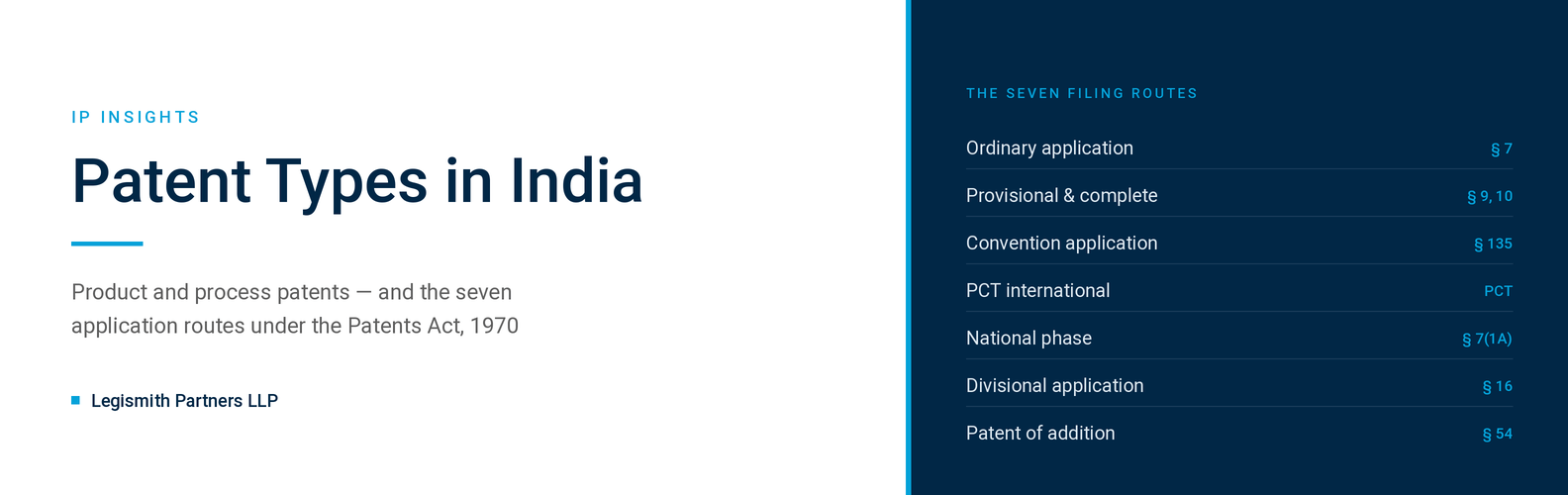
Here are the seven routes. Which one applies depends on where you filed first, and what stage your invention has reached.
1. Ordinary application (Section 7)
You file first in India, with no earlier application anywhere. This is the normal starting point for Indian inventors, start-ups and MSMEs. You submit Form 1 with a specification on Form 2.
2. Provisional and complete specification (Sections 9 and 10)
A provisional specification secures your filing date while the invention is still taking shape. It needs no claims. It is never published and never examined.
You must then file a complete specification within 12 months. This deadline cannot be extended. Miss it, and the application is deemed abandoned.
Please note: a provisional filing is not a “provisional patent”. It never becomes a patent on its own. Nothing is converted; a complete specification simply follows it.
3. Convention application (Section 135)
You filed first in another Paris Convention country and now want India. You have 12 months from that first filing to claim priority. A complete specification is required; the provisional route is closed to you.
4. PCT international application
A single international application, filed through IP India as the receiving office, which buys you time before choosing countries. The Patent Cooperation Treaty now covers 159 contracting states.
5. PCT national phase application (Section 7(1A))
This is how a PCT application enters India. The deadline is 31 months from the earliest priority date, and there is no standard provision for late entry.
Nearly 29% of Indian patent applications arrive this way. Our guide to national phase patent filing in India sets out the documents and timelines in full.
6. Divisional application (Section 16)
Used when one application contains more than one invention. You may file it yourself, or in answer to an objection from the Controller. The window closes permanently once the parent is granted.
In Syngenta Limited v. Controller of Patents and Designs, decided on 13/10/2023, a Division Bench of the Delhi High Court held that those inventions need only be disclosed in the specification. They need not appear in the parent claims.
7. Patent of addition (Section 54)
For an improvement to an invention you have already applied for or patented. It carries a useful advantage: no separate renewal fees for its whole life. It expires with the parent patent.
Comparing the Filing Routes at a Glance
Route | Section | Key deadline | Extendable? |
Ordinary application | 7 | — | — |
Provisional to complete | 9(1) | 12 months | No |
Convention application | 135 | 12 months from first filing | No |
PCT national phase | 7(1A) | 31 months from priority | No |
Divisional application | 16 | Before parent is granted | No |
Patent of addition | 54 | While parent is in force | — |
Request for examination | Rule 24B | 31 months | Limited |
Whichever route you take, the term is the same: 20 years from the filing date under Section 53. Renewal fees fall due from the third year and are paid after grant.
What Are the Official Patent Fees in India?
Fees depend on who you are, not which route you take. Individuals, start-ups, small entities and educational institutions pay roughly 80% less.
Item | Natural person, start-up or small entity | Large entity |
Filing (up to 30 pages, 10 claims) | ₹1,600 | ₹8,000 |
Request for examination | ₹4,000 | ₹20,000 |
Expedited examination | ₹8,000 | ₹60,000 |
Renewal, years 3–6 | ₹800 per year | ₹4,000 per year |
These figures are indicative. Confirm the current schedule on the official IP India portal before filing. Our patent fee calculator for India works through every stage, from filing to renewal.
Patent Fee Calculator
Calculate official Indian patent fees instantly — filing, examination, renewals, oppositions, PCT and more. DPIIT startup rates included. Based on the First Schedule of the Patents Rules.

What Changed in 2024?
The Patents (Amendment) Rules, 2024 altered several deadlines. Many older articles still quote the previous figures.
- The request for examination window fell from 48 months to 31 months for applications filed on or after 15/03/2024.
- Form 27, the working statement, is now filed once every three financial years rather than annually.
- Form 3 details are updated within three months of the First Examination Report.
- A new Form 31 sets out how to claim the 12-month grace period.
- Renewal fees paid electronically in advance for four years or more attract a 10% discount.
The shorter examination window matters most, because a provisional filing now uses up a large share of it. Our note on the Rule 12 and Form 3 amendments explains the reporting changes.
How Do You Choose the Right Route?
Work through these in order:
- Have you filed anywhere else? No — ordinary application. Yes, within 12 months — convention application. Yes, via a PCT filing — national phase within 31 months.
- Is the invention finished? If it is still developing, a provisional specification protects your date.
- Does it cover more than one invention? A divisional application separates them.
- Is it an improvement to something you already filed? A patent of addition may suit you better.
Before any of this, check the invention is genuinely new. A patentability search is the sensible first step, and far cheaper than finding prior art after examination begins.
What Cannot Be Patented in India?
Section 3 lists exclusions that catch many applicants by surprise:
- Section 3(d) — a new form of a known substance, without enhanced efficacy.
- Section 3(j) — plants and animals, including seeds and varieties.
- Section 3(k) — a mathematical or business method, or a computer programme per se.
The words “per se” carry real weight. Software with a genuine technical effect may still qualify. Our review of the leading patent cases of 2025 shows how the courts have applied this.
Common Mistakes to Avoid
- Treating a provisional filing as a granted patent.
- Missing the 12-month conversion deadline. It is absolute.
- Letting the parent application be granted before filing a divisional.
- Adding fresh technical matter to a divisional application.
- Forgetting renewal fees from the third year, which lets the patent lapse.
Frequently Asked Questions
How many types of patents are there in India?
The Act recognises product and process patents, and seven application routes. It does not divide patents into utility, design and plant categories.
Is there a utility patent in India?
No. Every Indian patent is what American practice calls a utility patent, so the term serves no purpose here.
How long does a patent last in India?
Twenty years from the filing date, provided renewal fees are paid from the third year onwards.
Can I file a design patent in India?
Not under that name. You apply to register a design under the Designs Act, 2000, which is a separate right with its own term.
Final Thoughts on Choosing Your Patent Route
Understanding patent types in India comes down to two questions. Are you protecting a product or a process? And where did you file first?
Answer those, and the route usually picks itself. The deadlines are where people come unstuck, because the important ones cannot be extended.
The system has come a long way. As the official history published by IP India records, it began in 1856 with a machine for pulling a ceiling fan. It now handles over a lakh applications a year.
At Legismith LLP we work across all seven routes. You can read more on our patent services page, or speak with our team about which one fits your position.
So, where does your invention stand today — an idea still taking shape, or a finished product ready to file?
Disclaimer
The content provided in this article is for general informational purposes only and does not constitute legal advice. Please consult with a qualified IP attorney for your specific needs.