
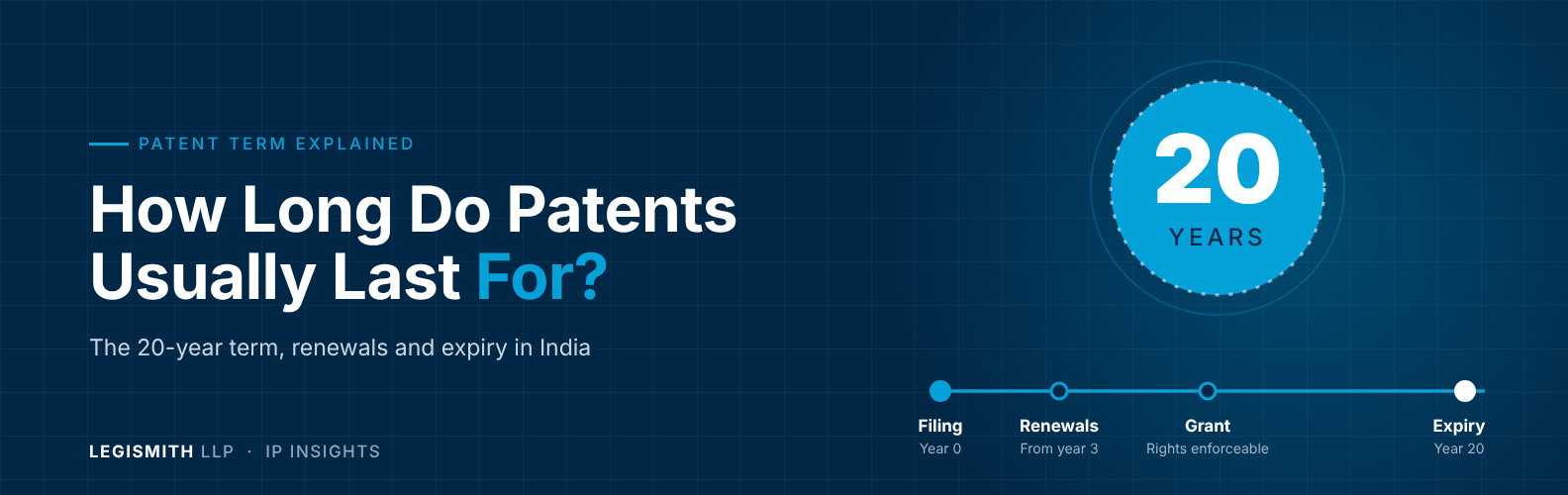
How long do patents usually last for? In India, and in most countries, a patent lasts for a maximum of 20 years from the date you file the application. That rule comes from Section 53 of the Patents Act, 1970.
The word “usually” matters, though. Many patents never reach year 20. Some lapse because renewal fees go unpaid. Others are given up, revoked or simply outlived by the technology.
At Legismith LLP, we often find that inventors know the 20-year figure but not the rules behind it. This guide answers the questions people ask most, one at a time.
How Long Do Patents Usually Last For in India?
A patent in India lasts for 20 years, counted from the filing date of the application. The term is the same for every field of technology, including medicines, software-related inventions and machinery.
Those 20 years are not the same as 20 years of protection. You can only sue for infringement after the patent is granted (Section 11A(7)). Grant often takes around four years, so the enforceable life of many patents is closer to 15 or 16 years.
The 20-year standard is near-universal because the TRIPS Agreement requires member countries to offer at least 20 years from filing. India adopted this rule through the Patents (Amendment) Act, 2002, which came into force on 20/05/2003.
Measure | What it means | Typical length |
Legal term | Maximum life set by Section 53 | 20 years from filing |
Enforceable life | From publication to expiry after grant | Often 15–16 years |
Actual life | Until the owner stops paying renewals | Varies; often shorter |
When Does the 20-Year Patent Term Start?
The clock starts on the date of filing in India, not the date of grant. The exact starting date depends on how you filed.
Provisional applications
A provisional application does start the clock. If you file a provisional specification first, the 20 years run from that provisional date. This differs from the US, where a provisional filing does not count towards the term.
Convention applications
The term runs from your Indian filing date, not the foreign priority date. Priority only fixes the date used to judge novelty.
PCT national phase applications
For a PCT application entering India, the term runs from the international filing date. Our guide to national phase patent filing in India explains the 31-month entry deadline.
Divisional applications and patents of addition
Neither gets a fresh term. A divisional application carries the parent’s filing date under Section 16(3), so it expires with the parent. A patent of addition ends with the main patent, but it needs no separate renewal fees (Sections 54 and 55).
Example filing | Term starts from | Expiry (if renewals are paid) |
Ordinary application filed 15/01/2026 | 15/01/2026 | 15/01/2046 |
Provisional filed 01/04/2025, complete filed 31/03/2026 | 01/04/2025 | 01/04/2045 |
US filing 10/02/2025, Indian convention filing 09/02/2026 | 09/02/2026 | 09/02/2046 |
PCT international filing date 05/06/2024 | 05/06/2024 | 05/06/2044 |
Why Don't Most Patents Last the Full 20 Years?
Unpaid renewal fees are the most common reason a patent ends early. If you stop paying, the patent ceases to have effect under Section 53(2). Many owners stop on purpose when a product no longer earns enough to justify the cost.
This happens more often than most people expect. Data from the United States suggests only about 4 in 10 patents are kept until the end of their term. Indian figures are not published in the same way, but the commercial logic is the same.
A patent can also end early through any of these events:
- Surrender — the owner gives it up voluntarily (Section 63).
- Post-grant opposition — anyone interested can challenge it within one year of grant publication (Section 25(2)).
- Revocation — the High Court can revoke it on grounds such as lack of novelty (Section 64).
- Public interest — the Government can revoke a patent it finds harmful to the public (Section 66).
How Do Renewal Fees Keep a Patent Alive?
Renewal fees start from the third year, counted from the filing date. The fee for each year must be paid before the previous year ends. No fees are due for the first two years.
If your patent is granted late, all the renewal fees that have built up become payable within three months of the grant being recorded in the register.
The fees rise as the patent gets older. The table below shows the statutory e-filing fees per year.
Patent year | Individual, start-up, small entity or educational institution | Other applicants |
3rd to 6th | ₹800 | ₹4,000 |
7th to 10th | ₹2,400 | ₹12,000 |
11th to 15th | ₹4,800 | ₹24,000 |
16th to 20th | ₹8,000 | ₹40,000 |
Across years 3 to 20, that adds up to about ₹76,800 for a small entity and ₹3,84,000 for other applicants. Confirm the current schedule on the official IP India portal, or use our patent fee calculator for India to estimate each stage.
Paying early can also reduce the cost. Since the Patents (Amendment) Rules, 2024, you get a 10% reduction when you pay renewal fees electronically in advance for at least four years. Our note on the 2024 Patents Rules amendments covers other changes from the same reform.
Patent Fee Calculator
Calculate official Indian patent fees instantly — filing, examination, renewals, oppositions, PCT and more. DPIIT startup rates included. Based on the First Schedule of the Patents Rules.

What Happens If You Miss a Renewal Payment?
A missed renewal is not the end straight away. You can pay up to six months late by filing Form 4 with an extension fee. If you still do not pay, the patent lapses.
A lapsed patent can be restored under Section 60. You must file Form 15 within 18 months of the date the patent ceased. You also need to show that the failure to pay was unintentional and that you acted without undue delay.
Restoration is not automatic. The Controller publishes the request and others may oppose it. Under Section 62, anyone who began using the invention in good faith while it had lapsed may also be protected.
A simple renewal calendar avoids all of this. If you manage several patents, we can walk you through how renewal deadlines are tracked for each one.
Can a Patent Be Extended Beyond 20 Years in India?
India does not allow a patent to be extended beyond 20 years. There is no patent term extension, no patent term adjustment and no supplementary protection certificate. Once 20 years from filing pass, the patent ends.
Articles that mention extensions are usually describing other countries. The US offers term adjustment for office delays and extensions of up to five years for some medicines. Europe offers supplementary protection certificates. These do not apply here.
Companies also cannot stretch protection by making small changes to a known drug. Section 3(d) blocks this practice, often called “evergreening”. A new form of a known substance is not patentable unless it shows better therapeutic efficacy. The Supreme Court upheld this in Novartis AG v. Union of India on 01/04/2013.
India’s position has stayed the same in recent trade talks. Reports on the India–UK trade agreement signed in July 2025 indicate it does not require term extensions or data exclusivity.
How Long Do Patents Last in Other Countries?
The basic 20-year rule is near-universal. The differences lie in extensions and design rights.
Jurisdiction | Invention patent | Design protection | Term extension? |
India | 20 years from filing | Registered design: 10 + 5 years | No |
United States | 20 years from filing | Design patent: 15 years from grant | Yes, for office delays and some medicines |
Europe | 20 years from filing | Up to 25 years | Yes, through supplementary protection certificates |
China | 20 years from filing | 15 years | Yes, in limited cases |
Japan | 20 years from filing | 25 years from filing | Yes, for medicines and agrochemicals |
An Indian patent is not valid abroad. Patents are territorial, so each country’s term, fees and expiry apply separately, even within the same patent family.
How Long Do Other IP Rights Last in India?
People often mix up patents with other IP rights. Each one has a different lifespan.
Right | How long it lasts | Law |
Patent | 20 years from filing | Patents Act, 1970 |
Registered design | 10 years, plus one 5-year extension | Designs Act, 2000 |
Trade mark | 10 years, renewable indefinitely | Trade Marks Act, 1999 |
Copyright (literary and artistic works) | Author’s lifetime plus 60 years | Copyright Act, 1957 |
Plant variety | 15 years (18 years for trees and vines) | PPV&FR Act, 2001 |
Trade secret | As long as it stays secret | Contract and common law |
If your product’s shape or appearance is what sets it apart, industrial design registration is the relevant right. A brand name, by contrast, can be protected for as long as you keep renewing your trade mark.
Secure Your Patent in India.
Learn about the statutory requirements and process for patent filing. Navigate complex legal frameworks with architectural precision and transparency.
How Long Did Patents Last in India Before 2003?
The term was not always 20 years. Under the original Patents Act, 1970, most patents lasted 14 years. Patents for processes making food, medicines or drugs lasted only 5 years from sealing or 7 years from the date of the patent, whichever was shorter.
Patents still in force on 20/05/2003 moved to the new 20-year term. India’s system began much earlier, in 1856, as the IP India history of the patent system records.
How Can You Check When a Patent Expires?
- Find the patent on IP India’s public search and note the filing date. For PCT patents, use the international filing date.
- Add 20 years to that date.
- Check the patent’s current status and renewal history on the IP India e-register.
- Look for related patents in the same family, such as divisionals, which may cover the same product.
Free tools such as Google Patents show “anticipated expiration” dates, but treat these as estimates. The Indian register is the official record. For PCT families, WIPO PATENTSCOPE helps you trace the international filing date.
What Happens When a Patent Expires?
Once a patent expires, anyone can use the invention. Section 53(4) states that the subject matter of an expired or ceased patent is no longer entitled to any protection. The invention enters the public domain.
Semaglutide shows how this works in practice. The widely used diabetes and weight-management medicine lost patent protection in India on 20/03/2026. More than 40 Indian manufacturers prepared generic versions, with prices expected to fall by around 50–60%. A similar pattern followed the expiry of sitagliptin in July 2022.
Expiry does not always mean you can make the product the next day. Other patents on formulations, processes or devices may still be live. Trade marks and designs may also protect the name and look. A freedom to operate analysis checks this before launch.
If you own a patent nearing expiry, review whether it still earns its renewal cost, consider licensing in the remaining years, and plan brand and design protection that outlasts it. Our guide to patent valuation explains how to weigh remaining term against value.
Frequently Asked Questions
Does the patent term start from filing or grant?
From filing. In India, the 20 years run from the filing date of the application, not the grant date.
Can I renew a patent after 20 years?
No. Renewal fees only keep a patent alive within its 20-year term. Unlike a trade mark, a patent cannot be renewed beyond it.
Do I lose patent years because examination is slow?
Yes. India does not compensate for examination delays. Filing a request for expedited examination on Form 18A, where eligible, can help you secure grant sooner.
How long does a provisional application protect my invention?
A provisional secures your filing date for 12 months. You must file a complete specification within that time, or the application is treated as abandoned.
How long does a design last in India?
Ten years from registration, with one extension of five years. That gives a maximum of 15 years.
Does a patent of addition last 20 years?
No. It lasts only as long as the main patent and needs no separate renewal fees.
Final Thoughts on How Long Patents Last
So, how long do patents usually last for? The legal answer in India is 20 years from filing, with no extensions. The practical answer is often shorter, because grant takes time and owners stop renewing patents that no longer pay their way.
The dates that matter most are your filing date, your renewal due dates and the 18-month restoration window. Keep those in view, and you keep control of your patent’s life.
At Legismith LLP, we help inventors and businesses understand these timelines across the full patent lifecycle. You can learn more on our patent services page.
Do you know the exact expiry date of the patents that matter most to your products?
Disclaimer
The content provided in this article is for general informational purposes only and does not constitute legal advice. Please consult with a qualified IP attorney for your specific needs.
Protect Your Innovation
Schedule your consultation with our expert IP attorneys to secure your assets and scale your brand globally. Partner with us to build a lasting legacy.