
You have a patent application number, but the portal shows nothing, or shows a status you do not understand. An Indian patent search by application number is the quickest way to see where any application stands, provided you know how to read the number and the result.
India received 1,43,729 patent applications in 2025–26, so lakhs of applicants are now tracking a number. At Legismith LLP, we often find that the confusion starts with the number itself. This guide explains what your number means, how to search it on the official portal, and what to do when the result is blank.
What does an Indian patent application number tell you?
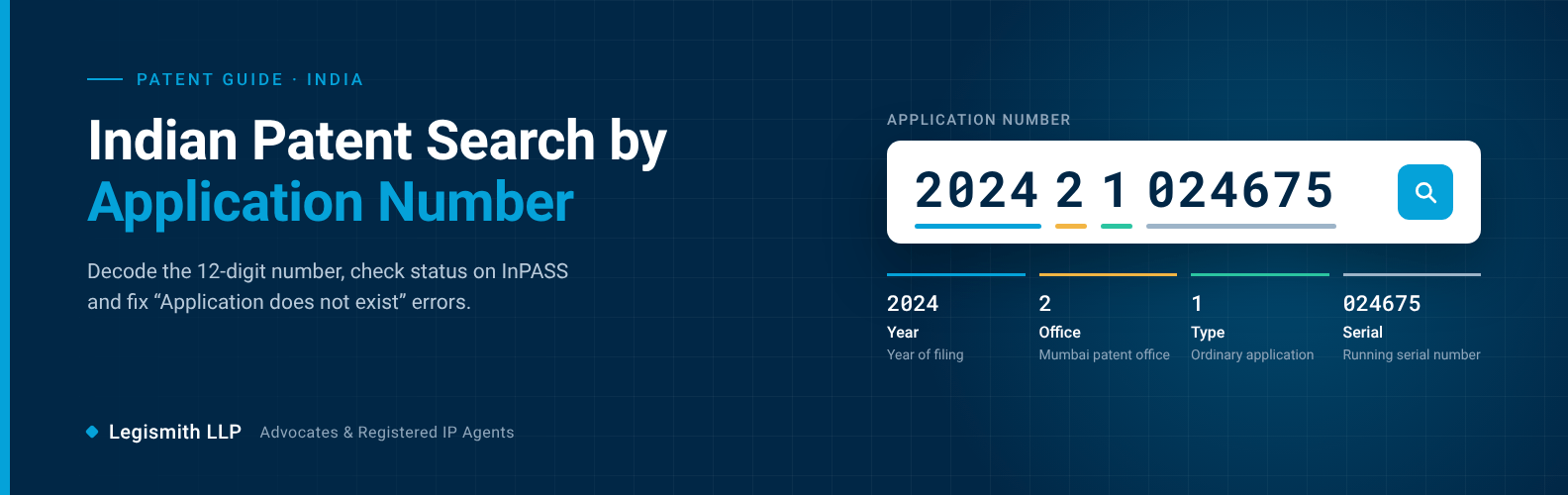
An Indian patent application number filed from 01/01/2016 onwards is a 12-digit code. It tells you the year of filing, the patent office that received it, the type of application and a serial number. Once you can read it, most search problems become easy to spot.
How do you decode the 12-digit application number?
You read the number in four parts: YYYY + J + T + NNNNNN. The table below shows what each part means.
Digits | What it shows | Possible values |
1–4 (YYYY) | Year of filing | For example, 2024 |
5 (J) | Patent office | 1 Delhi · 2 Mumbai · 3 Kolkata · 4 Chennai |
6 (T) | Type of application | 1 Ordinary · 2 Ordinary divisional · 3 Ordinary patent of addition · 4 Convention · 5 Convention divisional · 6 Convention patent of addition · 7 PCT national phase · 8 PCT national phase divisional · 9 PCT national phase patent of addition |
7–12 (NNNNNN) | Serial number | One running serial shared by all four offices |
For example, 202421024675 is an ordinary application filed at the Mumbai office in 2024. A number such as 202417xxxxxx would be a PCT national phase application filed in Delhi. Note that the fifth and sixth digits are separate codes, so “11” means “Delhi + ordinary”, not just “Delhi”.
What did application numbers look like before 2016?
Applications filed before 2016 use a serial / office / year format, such as 3285/CHENP/2009. The office codes were DEL, MUM, KOL and CHE, with “NP” added for PCT national phase filings. You must enter these numbers exactly as printed, including the slashes.
Is an application number the same as a patent number?
No. Your application number is given when you file, and your patent number is given only at grant. Many failed searches happen because people enter the wrong kind of number. Use this table to check which one you have.
Number type | Example | Where to use it |
Application number (2016 onwards) | 202421024675 | Application Status or Patent Search |
Application number (pre-2016) | 3285/CHENP/2009 | Application Status or Patent Search |
TEMP acknowledgement number | TEMP/E-1/12422/2020-DEL | Not searchable |
Patent number (after grant) | 345678 | Patent E-register |
PCT / WO number | WO2024/012345 | WIPO PATENTSCOPE, to find the Indian number |
How do you do an Indian patent search by application number?
You search the number on InPASS, the free Indian Patent Advanced Search System run by IP India. It takes about a minute and needs no login. Follow these steps:
- Open the IP India application status page.
- Enter your application number in the correct format, with no spaces.
- Type the CAPTCHA code shown on the screen.
- Click Show Status.
- Read the application details and the current status shown below them.
Can you search without the application number?
Yes. On the InPASS Patent Search tab, you can search by applicant name, inventor name, title or date range. Find your application in the results and click its number to open the full record.
How do PCT applicants find their Indian number?
India gives your PCT application a new Indian number when it enters the national phase. Your WO number will not work on InPASS. Search your PCT number on WIPO PATENTSCOPE and open the India national phase record to find it. Our guide to national phase patent filing in India explains this stage in detail.
What information does the status page show?
The status page shows the application’s key dates and its current stage. You will usually see the applicant, title, filing date, priority date, publication date, examination request date and the date of the first examination report (FER). The FER date matters most, because your reply deadline runs from it.
Below the details, buttons such as View Documents and Order(s)/Decision(s) let you open the full file. This includes examination reports, replies and the Controller’s orders.
What do the common patent status labels mean?
Each status label tells you which stage the application has reached and whether action may be due. The table below covers the labels you will see most often.
Status | What it usually means |
Application published | Published in the Patent Journal; check the examination request deadline |
Awaiting examination | Request for examination filed; waiting in the queue |
FER issued / under examination | Objections raised; a reply deadline is running |
In hearing | The Controller has fixed a hearing |
Granted | Patent number assigned; renewals now apply |
Refused (Section 15) | The Controller has refused the application |
Abandoned (Section 9(1) or 21(1)) | A statutory deadline was missed |
Deemed to be withdrawn (Section 11B(4)) | Examination was not requested in time |
Why does the filing date change how you read a status?
The deadline to request examination depends on when you filed. It is 31 months for applications filed on or after 15/03/2024, and 48 months for earlier ones, under the Patents (Amendment) Rules, 2024. The first four digits of your number tell you which rule applies.
Why has my status not changed for months?
“Awaiting examination” can last 12 to 24 months on the normal route. Examiner capacity has not kept pace with record filings, so a long wait is common. It does not mean your application is at risk, as long as your deadlines have been met.
If you are unsure whether a status needs a response, we can explain what it means for your application. You can schedule a call with our team to talk it through.
Why does the search say "Application does not exist"?
This message rarely means your application is missing. In most cases, it is caused by one of four things:
- Not yet published: Applications stay hidden for 18 months from filing or priority under Section 11A. You can file Form 9 to request early publication.
- TEMP number used: The TEMP number you get after online filing is only an acknowledgement. Use the permanent number on your filing receipt.
- Format error: Spaces in a 12-digit number, missing slashes in an old number, or a WO number in place of the Indian number.
- Secrecy direction: Applications under a secrecy direction (Section 35), usually for defence-related inventions, do not appear publicly.
How do you check whether a granted patent is still in force?
You use the Patent E-register with the patent number, not the application number. It shows whether the patent is in force, the renewal fee record and working statement filings. Renewals start from the third year, so a patent can lapse well before its 20-year term ends.
Can anyone search your patent application?
Yes. Once an application is published, anyone can view its status, applicant details and filed documents. Competitors, investors and buyers often do this before launching a product or signing a deal. Our article on freedom to operate analysis explains why these checks matter, and our guide to IP valuation covers due diligence.
Is it safe that your patent status is public?
Public data is useful, but it can be misused. On 17/10/2024, the Office of the CGPDTM warned that fraudsters were collecting application details from the IP India website. They then contact applicants by phone or email and ask for fees to “accept” the application.
Safety note: The Patent Office processes applications under the law and does not ask for payment over the phone to accept them. Official fees are paid only through the IP India e-filing portal. If you receive such a call, do not pay, and report it to the Patent Office.
Secure Your Patent in India.
Learn about the statutory requirements and process for patent filing. Navigate complex legal frameworks with architectural precision and transparency.
Frequently Asked Questions
Is the Indian patent status search free?
Yes. InPASS, the Application Status tab and the Patent E-register are free and need no registration.
How often is the status updated?
The status changes when the Patent Office records a new action, such as publication, examination or grant. It is not updated daily, so checking every few weeks is usually enough.
Can I see the examination report of someone else's application?
Yes. After publication, the View Documents option shows the examination report, replies and orders for any application.
Does the filing date on the status page affect my patent term?
Yes. A patent lasts 20 years from the filing date under Section 53 of the Patents Act, 1970, not from the grant date.
Final Thoughts on Searching an Indian Patent Application
An Indian patent search by application number is simple once you know what you are looking at. Decode the number first, use the right tab for the right number, and read the status alongside its deadline. Most blank results come from timing or format, not from a lost application.
At Legismith LLP, we believe applicants who understand their status make better decisions about deadlines and next steps. You can learn more about each stage on our patent services page, or get in touch if a status on your application needs explaining.
Which status label have you found the hardest to understand?
Disclaimer
The content provided in this article is for general informational purposes only and does not constitute legal advice. Please consult with a qualified IP attorney for your specific needs.
Protect Your Innovation
Schedule your consultation with our expert IP attorneys to secure your assets and scale your brand globally. Partner with us to build a lasting legacy.