
Thousands of people search for design patent filing in India every month. There is one problem with the phrase: India has no design patent.
What you actually file is an application to register a design under the Designs Act, 2000. The term “design patent” comes from the United States, and most Indian websites repeat it without explaining the difference. This guide walks through the real process, form by form, and the timing rule that decides whether your registration survives a court challenge.
Design Patent Filing in India: What You Are Actually Filing
A patent protects how a product works. A registered design protects how it looks. Separate rights, separate laws.
What people search for | What India calls it |
Design patent | Registered design |
Design patent application | Form 1 application for registration of a design |
Design patent office | Designs Wing, Patent Office, Kolkata |
Design patent grant | Certificate of registration |
Section 2(d) of the Designs Act, 2000 defines a design as the features of shape, configuration, pattern, ornament or composition of lines or colours applied to an article. One phrase does most of the work: the design must be judged solely by the eye. No expert evidence, no technical merit, just whether it looks different.
What Can and Cannot Be Registered as a Design
Your design must be new and original, and novelty here is global. Publication anywhere in the world before your filing date destroys it.
According to the official guidance published by IP India, an application will be refused if the design:
- is not new or original, or has already been published;
- cannot be distinguished from a known design;
- is dictated solely by function or mechanical construction;
- is really a trade mark, property mark or artistic work; or
- is obscene or scandalous.
That third point catches many applicants. If a shape exists only because the product could not work otherwise, it is not a design. Function belongs to the patent system.
Protect Your Product's Design.
Stop copycats. File your design patent quickly and affordably. Secure the aesthetic identity that defines your brand’s authority.
File Before You Show It to Anyone
This is the rule that matters most, and where American advice becomes dangerous. The United States gives you a one-year grace period after public disclosure. India gives you nothing of the sort, beyond a narrow six-month exception for officially recognised exhibitions. A trade fair stall, a launch video, a social media post, or a page on your own website can all count as publication.
In June 2026, the Delhi High Court applied this strictly. A cooler manufacturer sued a competitor for copying its registered design. The defence showed the company had been selling the same cooler, and displaying it on its own website, months before filing. The Court treated the registration as invalid, and the infringement case failed.
The lesson is uncomfortable but simple. Your own marketing can destroy your own registration. File first, launch second.
If you are unsure whether something you have shown already counts as publication, check before you spend money on an application. Our industrial design registration services page explains how we approach that assessment.
How to File a Design Application in India: Step by Step
Step 1: Search for existing designs
Start with the public design search on the IP India portal. Because novelty is global, the Global Design Database maintained by WIPO is a sensible second stop.
Step 2: Choose the right Locarno class
India uses the Locarno Classification system, which has 32 classes. Section 5(3) allows only one class per application, so articles in two classes need two applications and two fees. Choosing the wrong class is a common cause of objections.
Step 3: Prepare the representation sheet
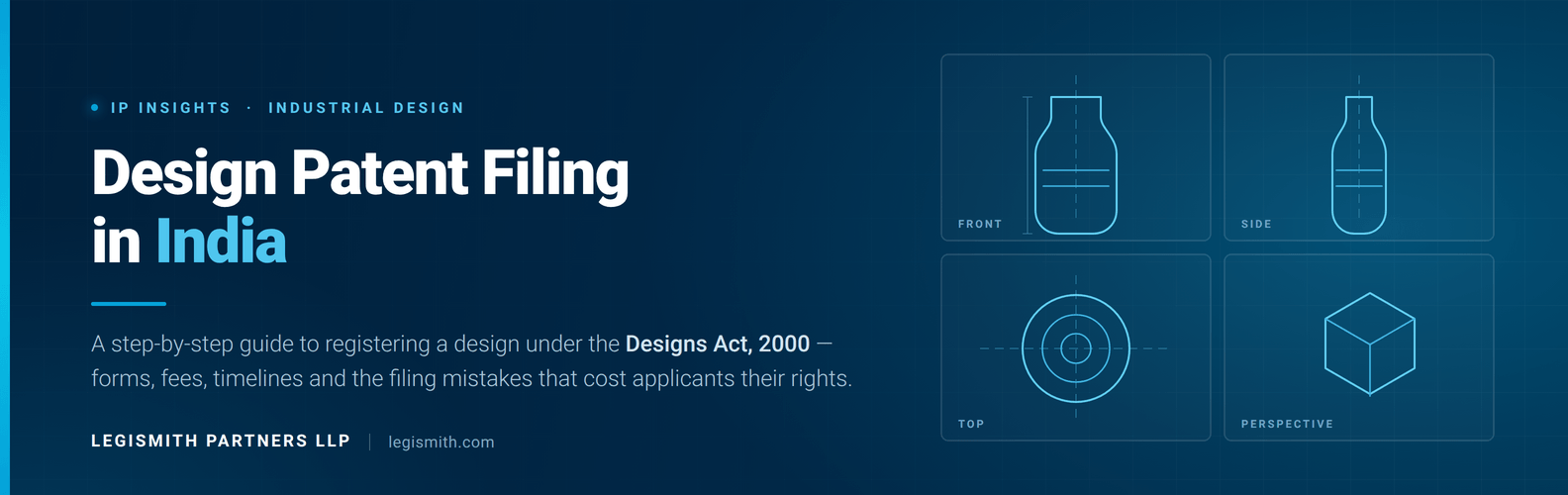
Your drawings are your application. Prepare clear, consistent views of the article, usually front, rear, left, right, top, bottom and perspective, against a plain background.
If words, logos or trade marks appear on the article, add a disclaimer stating that no rights are claimed in them, plus a short statement of novelty explaining what is new.
Step 4: Complete Form 1, and Form 24 if you want the lower fee
Form 1 carries your name, address, the name of the article, the Locarno class and an address for service in India.
If you are claiming the reduced fee as a startup or small entity, you must also file Form 24 with supporting proof. Many applicants miss this and are charged the higher rate.
Step 5: File and pay
E-filing is the practical route, as physical filing carries a surcharge of around 10%. Applications go to the Designs Wing of the Patent Office in Kolkata, with branch offices in Delhi, Mumbai and Chennai.
Step 6: Examination and objections
Unlike patents, designs need no separate request for examination. It happens automatically. If the examiner raises objections, you generally have six months from the application date to respond, extendable by three months using Form 18. Miss it, and the application is treated as abandoned.
Step 7: Registration and publication
Once the Controller is satisfied, a certificate issues and the design is published in the Patent Office Journal. Registration is backdated to your application date, or your priority date if you claimed one.
Step 8: Mark your product
This step is cheap and often skipped. Section 15 requires registered articles to be marked, usually with “Regd.” and the registration number. Failing to mark can limit the damages you recover from an infringer later.
Design Patent Filing Fees in India
Design filing is one of the more affordable IP rights in India. The figures below are indicative, so always confirm the current schedule on the IP India portal before filing.
Filing | Form | Individual, startup or small entity | Other applicants |
Application for registration (per class) | Form 1 | ₹1,000 | ₹4,000 |
Renewal of the registered design | Form 3 | ₹2,000 | ₹8,000 |
Restoration of a lapsed design | Form 4 | ₹1,000 | ₹4,000 |
Extension of time (per month) | Form 18 | ₹200 | ₹800 |
How Long Does Design Registration Take?
A clean application usually reaches registration in roughly 7 to 12 months. Where objections are raised, one to two years is more realistic. You may see claims online of registration in four months, but treat those with caution.
The variables are your drawings, your class, and how quickly you answer the examiner.
Renewal, Lapse and Restoration
A registered design lasts 10 years from registration, extendable once by 5 years, giving a maximum of 15.
That extension is not automatic. You must apply on Form 3 before the first term expires. If the design lapses, Section 12 allows restoration within one year, but that is a recovery route, not a plan.
If You Read About Design Patents on a US Website
United States | India | |
Grace period after disclosure | 12 months | None, except six months for recognised exhibitions |
Term | 15 years from issue | 10 years, plus one 5-year extension |
Renewal needed? | No maintenance fees | Yes, before expiry |
Convention priority window | 6 months | 6 months, non-extendable |
The grace period is the difference that costs people their rights. Do not rely on it here.
Common Design Patent Filing Mistakes
- Launching before filing.The most expensive mistake, as the 2026 cooler decision showed.
- Choosing the wrong Locarno class. This produces an objection and delays registration.
- Weak representations. Inconsistent views, cluttered backgrounds and missing disclaimers are the usual culprits.
- Claiming the reduced fee without Form 24. The lower rate needs proof.
- Missing the renewal date. There is no second chance once the term ends.
It is also sensible to confirm that your own product does not infringe someone else’s registered design. Our guide to freedom to operate analysis explains why that check belongs early in development, not after tooling is paid for.
What May Change in Design Filing
Design filing here is growing fast. Applications reached 43,005 in 2024–25, a rise of roughly 41% in one year, and the World Intellectual Property Indicators 2025 report shows India recorded the fastest design growth of any major filing origin.
The law is being reviewed to keep pace. A concept note published by DPIIT in January 2026 proposes express protection for graphical user interfaces and animations, a blanket 12-month grace period, deferred publication of up to 30 months, and accession to the Hague Agreement.
These are proposals, not law. India is not currently a Hague member, so protection abroad still means filing country by country within the six-month priority window.
Final Thoughts on Design Patent Filing
Design patent filing in India is quicker and cheaper than most applicants expect. The difficulty is rarely the paperwork. It is the timing. Search first, pick the right class, prepare proper drawings, and file before your product meets the public.
If your product’s shape has also become recognisable to buyers, our guide to trademark registration in India covers what happens after design protection ends. If the innovation is functional rather than visual, our patent services page covers that route.
So, before you file, ask yourself one question: has your design already been shown to anyone outside your organisation, and do you know exactly when? If you are not certain, you are welcome to get in touch with our team to talk it through.
Disclaimer
The content provided in this article is for general informational purposes only and does not constitute legal advice. Please consult with a qualified IP attorney for your specific needs.
Protect Your Innovation
Schedule your consultation with our expert IP attorneys to secure your assets and scale your brand globally. Partner with us to build a lasting legacy.