
In 2024–25, India received 1,10,375 patent applications. In the same year, 33,504 patents were granted. The patent granting procedure is what sits between those two numbers.
Most guides describe it as a simple queue. It is not. It is a sequence of fixed deadlines, and one of the most important ones changed in 2024. A great deal of published advice still quotes the old figure.
At Legismith LLP, we work through this process every week. Below is what actually happens, stage by stage, with the section or rule behind each step.
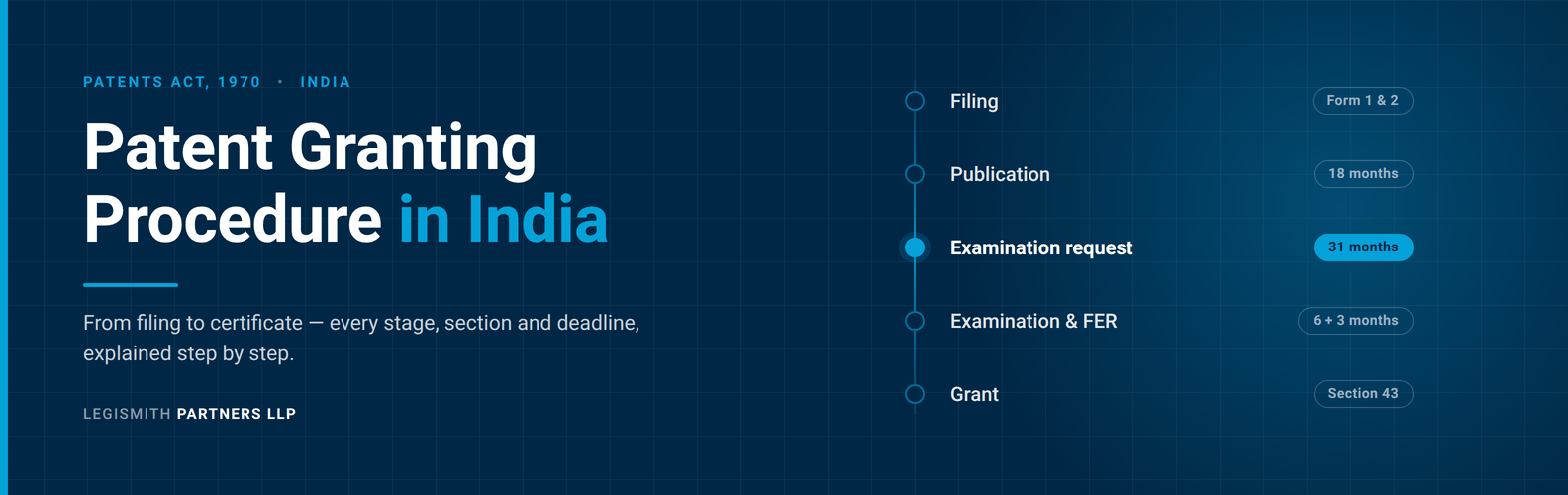
The Patent Granting Procedure in India at a Glance
Here is the full route, from filing to certificate.
Stage | Section or Rule | Deadline |
File the application | Section 7 | — |
Publication | Section 11A | 18 months from filing or priority |
Pre-grant opposition window | Rule 55(1A) | No grant for 6 months after publication |
Request examination | Rule 24B(1)(i) | 31 months |
First Examination Report | Section 14 | Issued by the Controller |
Reply to the report | Section 21(1) | 6 months, plus 3 on request |
Hearing | Rule 28 | 10 days’ notice |
Grant of patent | Section 43 | — |
Certificate issued | Rule 74 | Within 7 days of grant |
How Do You File a Patent Application in India?
The process starts with Form 1, the application itself, and Form 2, which carries your specification. You will usually file Form 3 as well, declaring any matching applications filed abroad.
Form 5 records who invented the subject matter. Form 26 appoints your agent, and Form 28 claims small entity or start-up status, which cuts the official fees sharply.
Before any of this, check that the invention is new. The public patent search maintained by IP India is free to use. Our guide to patent e-filing in India covers the portal itself.
Protect Your Product's Design.
Stop copycats. File your design patent quickly and affordably. Secure the aesthetic identity that defines your brand’s authority.
What Happens After Filing?
Publication under Section 11A
Your application is published automatically 18 months after the filing or priority date, whichever is earlier. You can bring this forward by filing Form 9.
Publication is not grant. It simply means the application is now public, and anyone can read it.
The six-month rule most guides leave out
Rule 55(1A) says no patent may be granted before six months have passed from publication. That window exists so any person can file a pre-grant opposition under Section 25(1).
This is the real floor on how quickly a patent can be granted, however fast examination moves. Since 15/03/2024, the Controller must first decide whether an opposition discloses a prima facie case, and a fee is now payable.
When Must You Request Examination?
Nothing happens to your application until you ask for it. You must file Form 18 within 31 months of the earliest priority or filing date, under Rule 24B(1)(i).
This is the change that catches people out. The window used to be 48 months. It was cut to 31 months for applications filed on or after 15/03/2024. Older applications keep the earlier period.
Please note: if you miss this deadline, the application is treated as withdrawn under Section 11B(4). Rule 137(2)(iv) rules out condonation. There is effectively no way back.
Can you speed the process up?
Yes. Form 18A requests expedited examination under Rule 24C. You qualify if you are a start-up, a small entity, a female applicant, a government body, or if India acted as your international searching authority.
Examination and the First Examination Report
An examiner searches for prior art under Sections 12 and 13, then reports to the Controller. The Controller issues a First Examination Report, usually called the FER.
The FER lists objections. Some are technical, on novelty or inventive step. Others are formal. An FER is normal, and it is not a rejection.
You then have six months from the FER date to put the application in order, under Section 21(1). Form 4 buys you three more months, and that is the limit.
You must also update Form 3 within three months of the FER. Our note on the Rule 12 and Form 3 amendments explains how that reporting now works.
The Hearing and the Controller's Decision
If objections remain outstanding, the Controller calls a hearing. Rule 28 requires at least ten days’ notice, and you may file written submissions within fifteen days afterwards.
When is a patent granted?
Section 43 is the operative provision. A patent is granted as expeditiously as possible once the application is in order, has not been refused, and does not contravene the Act.
The grant is then published, and the file opens to public inspection. Under Rule 74, the certificate is ordinarily issued within seven days of grant.
What if the application is refused?
Section 15 allows the Controller to refuse the application or require amendments. A refusal is not final. Appeals now go to the High Courts, since the IPAB was wound up on 04/04/2021.
The courts have taken this seriously. In several matters the Delhi High Court has set aside refusals that gave inadequate reasons, or that rested on grounds never put to the applicant. Our review of the leading patent cases of 2025 traces how this thinking has developed.
What Happens After the Patent Is Granted?
Grant is not the finish line. Three obligations begin straight away.
- Post-grant opposition. Any interested person may oppose within 12 months of the grant being published, under Section 25(2).
- Renewal fees. Payable from the third year under Section 53(2). Miss them and the patent lapses.
- Form 27. A statement of working, now filed once every three financial years under Rule 131. The first deadline under the new cycle falls on 30/09/2026.
A granted patent also stops others from working your invention. It does not confirm that you are free to sell your own product. That is a separate question, and our guide to freedom to operate analysis explains why the two are often confused.
How Long Does the Patent Granting Procedure Take?
On the ordinary route, expect two to four years from the examination request. On the expedited route, one to two years is realistic. At Legismith LLP we plan filing dates around those windows rather than around the grant itself.
The old picture of an eight to ten year wait no longer reflects practice. The Patent Office onboarded 407 new examiners in 2024–25 alone, and its sanctioned strength has more than tripled since 2014.
The figures support this. According to the World Intellectual Property Indicators published by WIPO, 78.6% of Indian applications processed in 2024 ended in a grant, and patents in force reached 2,28,402.
What Does the Patent Granting Procedure Cost?
Fees depend on who you are, not how complex the invention is.
Stage | Individual, start-up or small entity | Large entity |
Filing (up to 30 pages, 10 claims) | ₹1,600 | ₹8,000 |
Request for examination | ₹4,000 | ₹20,000 |
Expedited examination | ₹8,000 | ₹60,000 |
Early publication | ₹2,500 | ₹12,500 |
Renewal, years 3–6 | ₹800 per year | ₹4,000 per year |
These figures are indicative. Confirm the current schedule on the official IP India portal before you file. Our patent fee calculator for India works through every stage, including renewals.
Patent Fee Calculator
Calculate official Indian patent fees instantly — filing, examination, renewals, oppositions, PCT and more. DPIIT startup rates included. Based on the First Schedule of the Patents Rules.

Common Mistakes in the Patent Granting Procedure
- Assuming publication means the patent has been granted.
- Working to a 48-month examination deadline that no longer applies.
- Planning for twelve months to answer an FER, when the period is six.
- Never checking whether you qualify for expedited examination.
- Forgetting renewal fees from the third year, which lets the patent lapse.
Frequently Asked Questions
How long does the patent granting procedure take in India?
Usually two to four years from the examination request, or one to two years if expedited examination is granted.
What is the difference between publication and grant?
Publication makes the application public at 18 months and gives you no rights. Grant is a separate decision under Section 43, and only then can you enforce the patent.
Is the examination deadline 31 months or 48 months?
It is 31 months for applications filed on or after 15/03/2024. Applications filed before that date keep the 48-month window.
Can a refused patent application be appealed?
Yes. An appeal against a refusal under Section 15 lies to the High Court.
When does the patent certificate arrive?
Rule 74 provides that it is ordinarily issued within seven days of the grant.
Final Thoughts on the Patent Granting Procedure
The patent granting procedure rewards applicants who track dates rather than outcomes. Examination does not begin on its own, publication confers nothing, and the two deadlines that matter most cannot be extended.
Once the certificate arrives, the work shifts to keeping the right alive and understanding what it is worth. Our complete guide to IP valuation is a useful next read.
At Legismith LLP we take applications through every stage of this route, from drafting to grant. You can read more on our patent services page, or speak with our team about where your application stands.
So, which stage are you at today — waiting for publication, or counting down to the examination request?
Disclaimer
The content provided in this article is for general informational purposes only and does not constitute legal advice. Please consult with a qualified IP attorney for your specific needs.
Protect Your Innovation
Schedule your consultation with our expert IP attorneys to secure your assets and scale your brand globally. Partner with us to build a lasting legacy.