
You have an invention, and you think it could sell beyond India. Filing separately in every country is slow and costly. PCT application filing lets you file one international application and keep your options open in 159 countries. About 275,900 such applications were filed worldwide in 2025, according to WIPO’s PCT Yearly Review 2026.
But a PCT application is not an “international patent”. There is no such thing. What you get is a single filing date, an early search report and time to decide where to go next.
At Legismith LLP, we see the same two mistakes again and again. One happens before filing, under Section 39. The other happens at 31 months. This guide walks you through both, and every step in between.
What Does PCT Application Filing Give You?
The Patent Cooperation Treaty (PCT) is run by the World Intellectual Property Organization (WIPO). Under Article 11(3), an international application with a filing date has the effect of a regular national application in each member country.
In practice, this means three things:
- One filing date that counts in every member country.
- One search report on your invention, before you spend heavily.
- Up to 30 or 31 months from your first filing to choose your countries.
Each country still examines and grants its own patent. If you are new to the treaty itself, our explainer on what the Patent Cooperation Treaty is covers the basics.
Do You Need Permission Before Filing a PCT Application From India?
Very often, yes. Section 39 of the Patents Act, 1970 stops any person resident in India from applying for a patent abroad without clearance. It depends on where you live, not your nationality.
This rule applies even when you file your PCT application at the Indian Patent Office. You have two ways to comply:
- File in India first and wait six weeks. You may then file abroad, provided no secrecy direction has been issued under Section 35.
- Apply for a written permit on Form 25. Under Rule 71, the Controller ordinarily decides the request within 21 days.
Please note: an application made in breach of Section 39 is deemed abandoned under Section 40, and any patent granted may be revoked. Under Section 118, the breach can also lead to imprisonment of up to two years, a fine, or both.
Pune's Trusted IPR Experts.
Speak directly with experienced professionals to navigate complex legal frameworks.
Step-by-Step PCT Application Filing From India
Here is the route most Indian applicants follow, from the first filing to the national phase.
Step 1: File your Indian priority application
Most applicants begin with a provisional or complete application at IP India. This date becomes your priority date, and every PCT deadline is counted from it.
Before filing, check that the invention is new. Our guide to patent search in India explains how to do this. Since 01/01/2026, the PCT rules also count some non-written disclosures as prior art. So keep the invention confidential until you have filed.
Step 2: File the PCT application within 12 months
You must file your PCT application within 12 months of the priority date to claim that date. You can file it in one of two places:
- The Indian Patent Office as receiving office (RO/IN), at Kolkata, New Delhi, Chennai or Mumbai.
- WIPO’s International Bureau (RO/IB), usually through WIPO’s ePCT filing system.
You file the request form (PCT/RO/101), the description, claims, abstract and any drawings, in English or Hindi. The WIPO PCT Applicant’s Guide for India lists the requirements in full.
Step 3: Choose your International Searching Authority
An International Searching Authority (ISA) searches for earlier inventions like yours. If you file from India, you can choose from eight offices: Austria, Australia, China, the European Patent Office, India, Japan, Sweden and the United States.
This choice matters more than it seems. It is fixed at filing and cannot be changed later. If India is your ISA, a foreign or large-entity applicant can later request expedited examination on Form 18A under Rule 24C, when the application enters India.
Step 4: Receive the search report and written opinion
The ISA sends an International Search Report and a Written Opinion, usually around 16 months from priority. Together, they tell you how your claims look against the prior art.
You may amend your claims once under Article 19 after receiving the report.
Step 5: International publication at 18 months
WIPO publishes your application promptly after 18 months from the priority date. Anyone can then read it on WIPO’s PATENTSCOPE database.
Step 6: Optional Chapter II demand by 22 months
If the written opinion raises objections, you can file a “demand” for international preliminary examination. This is due by 22 months from priority, or three months from the search report, whichever is later.
Chapter II gives you a chance to argue with the examiner and amend before national phase costs begin. It is optional, and many applicants skip it.
Step 7: Enter the national phase at 30 or 31 months
This is where the PCT ends and country-by-country examination begins. Most countries, including the US, China and Japan, allow 30 months. India, the European Patent Office and Korea allow 31 months.
For India, note one detail. The request for examination (Form 18) is also due within 31 months of priority under Rule 24B(1)(i). For a PCT application, the two deadlines fall together. Our guide to national phase patent filing in India covers this step in detail.
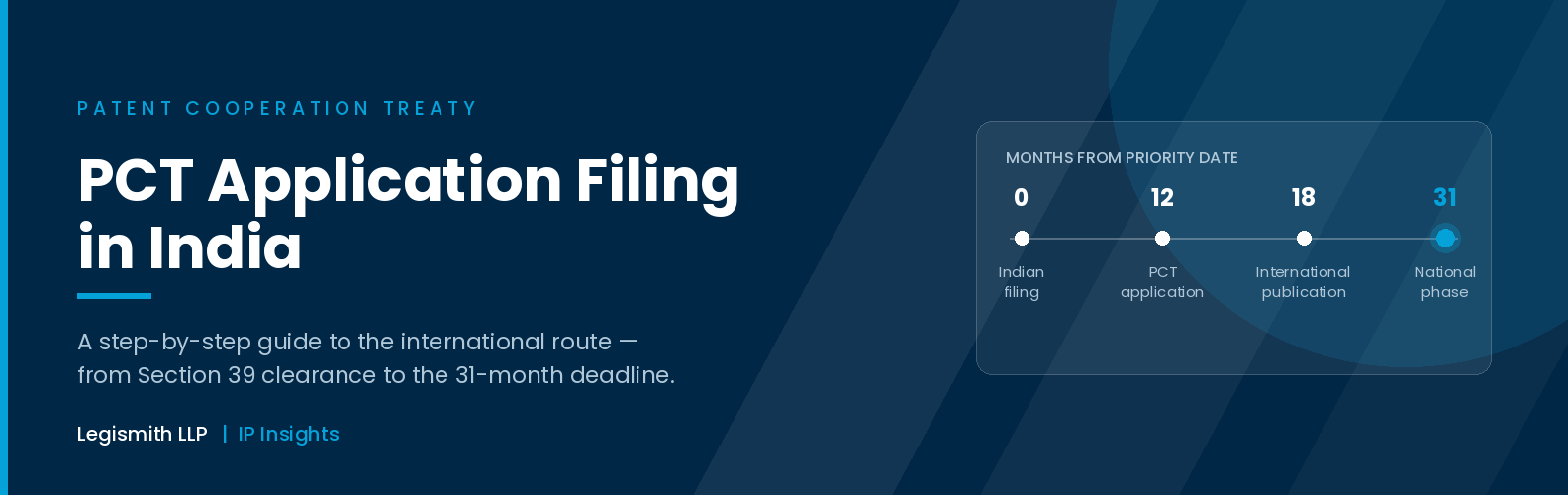
PCT Timeline at a Glance
Month from priority | What happens | Provision |
0 | Indian priority application filed | Section 7 |
6 weeks | Earliest foreign filing without a permit | Section 39 |
12 | Last day to file the PCT application | PCT Article 8 |
About 16 | Search report and written opinion | PCT Rule 42 |
18 | International publication | PCT Article 21 |
22 | Chapter II demand (optional) | PCT Rule 54bis |
30 | National phase in most countries | PCT Article 22 |
31 | National phase and Form 18 in India | Rules 20(1) and 24B |
What Are the PCT Application Filing Fees in India?
Costs arrive in two waves. The international phase is the smaller one. The national phase, from 30 or 31 months onwards, is where most of the money goes.
International phase fees
These apply when you file at the Indian Patent Office. The reduced column covers a natural person, start-up, small entity or educational institution.
Fee | Reduced category | Others |
Transmittal fee, filed through ePCT | Nil | Nil |
Transmittal fee, e-filing at the IP India portal | ₹3,200 | ₹16,000 |
Transmittal fee, paper filing | ₹3,500 | ₹17,600 |
Certified copy of the priority document, e-filing | ₹1,000 | ₹5,000 |
International filing fee, up to 30 sheets | USD 1,667 | USD 1,667 |
Each sheet over 30 | USD 19 | USD 19 |
Search fee, India as ISA | ₹2,500 | ₹10,000 |
Preliminary examination, India also searched | ₹2,500 | ₹10,000 |
Preliminary examination, another office searched | ₹3,000 | ₹12,000 |
Handling fee, Chapter II | USD 251 | USD 251 |
Two points cause most of the confusion here.
- The 90% WIPO reduction cuts the international filing fee to roughly USD 167. It applies only to natural persons from eligible countries, and India is on that list. Every applicant named on the form must qualify, so a company or a start-up does not get it.
- The transmittal fee depends on how you file, not just that you file online. The First Schedule waives it only for applications filed through WIPO’s ePCT system. File electronically on the IP India portal instead, and it is ₹3,200 or ₹16,000. Either way, WIPO also reduces the international filing fee by USD 251 or USD 376, depending on the format.
Indian national phase fees
When the application reaches India at 31 months, the statutory fees below apply on e-filing. Physical filing costs more.
Fee | Reduced category | Others |
Entry on Form 1, up to 30 pages and 10 claims | ₹1,600 | ₹8,000 |
Each page over 30 | ₹160 | ₹800 |
Each claim over 10 | ₹320 | ₹1,600 |
Request for examination, Form 18 | ₹4,000 | ₹20,000 |
Expedited examination, Form 18A | ₹8,000 | ₹60,000 |
Renewal, years 3 to 6 | ₹800 per year | ₹4,000 per year |
Two costs sit outside both tables. Translation, where a country requires it, and the local agent you must appoint in each country you enter. For most applicants, these outweigh the official fees.
WIPO sets the international filing fee at CHF 1,330, and each receiving office collects the equivalent in its own currency, so the dollar figure moves with exchange rates. Check the current amounts in the official PCT fee tables and the First Schedule to the Patents Rules before you file. Our PCT national phase fee calculator estimates the Indian leg stage by stage.
Patent Fee Calculator
Calculate official Indian patent fees instantly — filing, examination, renewals, oppositions, PCT and more. DPIIT startup rates included. Based on the First Schedule of the Patents Rules.

Which PCT Deadlines Can India Not Extend?
Some countries let you restore a missed priority date or re-enter a late national phase. India does not.
WIPO’s list of reservations and incompatibilities under the PCT shows that India has opted out of the rules on restoring priority. In plain terms:
- Miss the 12-month window, and your PCT application cannot claim the Indian priority date.
- Miss the 31-month national phase deadline, and you cannot enter India.
That is why we treat both dates as fixed from the day the priority application is filed.
Common Mistakes to Avoid
- Filing abroad within six weeks of the Indian filing, without a Form 25 permit.
- Assuming a start-up qualifies for the 90% WIPO fee reduction.
- Calling the first Indian filing a “national phase application”. The national phase comes at the end, not the start.
- Choosing a search authority without thinking about examination in India later.
- Forgetting that Form 18 falls due with Indian national phase entry.
Frequently Asked Questions
Does PCT application filing give me a worldwide patent?
No. It gives you one filing date and one search. Each country decides whether to grant a patent at the national phase.
Can I file a PCT application without filing in India first?
If you live in India, only with a Form 25 permit from the Controller under Section 39.
What is the national phase deadline for India?
31 months from the priority date. Late entry is not permitted.
Is the PCT worth it if I need only one or two countries?
Not always. A direct filing under the Paris Convention, within 12 months, can be simpler. The PCT helps most when you need time or several markets.
Final Thoughts on PCT Application Filing
PCT application filing buys you time, not a patent. Get the Section 39 clearance right, file within 12 months, choose your search authority with India in mind, and treat 31 months as final.
At Legismith LLP, we handle both the Indian priority filing and the international phase. You can read more on our patent services page, or speak with our team about your filing timeline.
So, which countries are you considering for your invention, and have you mapped your 12- and 31-month dates yet?
Disclaimer
The content provided in this article is for general informational purposes only and does not constitute legal advice. Please consult with a qualified IP attorney for your specific needs.
Protect Your Innovation
Schedule your consultation with our expert IP attorneys to secure your assets and scale your brand globally. Partner with us to build a lasting legacy.