
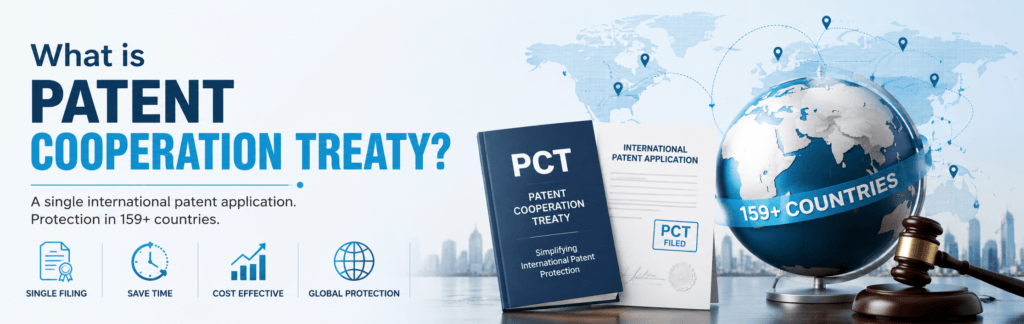
What is Patent Cooperation Treaty?
If you have developed an invention and plan to seek patent protection in multiple countries, filing separate patent applications in every jurisdiction can be expensive and complex. The Patent Cooperation Treaty (PCT) was created to simplify this process by allowing applicants to file a single international patent application that can later be pursued in multiple countries.
The Patent Cooperation Treaty is an international treaty administered by the World Intellectual Property Organization (WIPO). It provides a unified procedure for seeking patent protection across numerous countries through one international filing. However, it is important to understand that a PCT application does not grant an international patent. Patent rights are ultimately granted by individual national or regional patent offices.
At Legismith LLP, we often find that inventors, startups, and businesses misunderstand the role of the PCT system. The treaty serves as a procedural framework that simplifies international patent filing while providing applicants with additional time to evaluate commercial opportunities before entering individual countries.
History of the Patent Cooperation Treaty
The Patent Cooperation Treaty was signed in Washington in 1970 and entered into force in 1978. It was introduced to address the growing need for a streamlined international patent filing mechanism.
Since its implementation, the PCT system has become one of the most widely used international intellectual property frameworks. More than 5 million PCT applications had been published worldwide by 2024, demonstrating its significance in the global innovation ecosystem.
Purpose of the PCT System
The primary purpose of the PCT is to:
- Simplify international patent filing.
- Reduce duplication of administrative formalities.
- Provide a comprehensive international prior art search.
- Allow applicants additional time before committing to national filings.
- Facilitate informed patenting decisions based on search reports and written opinions.
A single PCT application can potentially cover more than 159 contracting states, representing over 90% of global GDP and approximately 87% of the world’s population.
Interesting Facts About the PCT
- The Bahamas became the 159th PCT Contracting State on 19/05/2026.
- Uruguay joined as the 158th member in 2025.
- WIPO’s PATENTSCOPE database now provides access to over 127 million patent documents.
- Certain applicants from eligible developing countries may receive a 90% reduction in international filing fees.
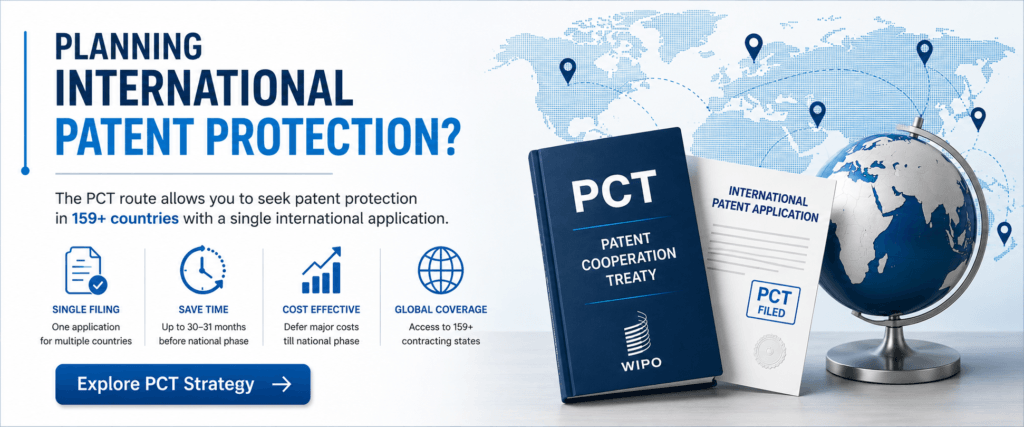
- The PCT system generally extends the deadline for foreign filings from 12 months to approximately 30–31 months.
Patent Cooperation Treaty Objectives and Eligibility
Objectives of the Patent Cooperation Treaty
The Patent Cooperation Treaty seeks to create a more efficient international patent filing process by:
- Providing a standardised filing procedure.
- Improving patent information accessibility.
- Reducing repetitive examination work across patent offices.
- Supporting innovation and technology transfer globally.
- Enhancing the quality of international patent searches.
Recent PCT Developments
Significant amendments to PCT Rules 34, 36, and 63 came into effect on 01/01/2026.
These changes expanded the minimum patent documentation available to International Searching Authorities by incorporating 19 additional national patent collections. This improvement enhances prior art searches and increases the reliability of patentability assessments.
Furthermore, participating patent offices have begun exchanging full-text patent application data instead of image-based documents, enabling more accurate text-based searching and analysis.
Who Can File a PCT Application?
A PCT application can generally be filed by:
- Nationals of a PCT Contracting State.
- Residents of a PCT Contracting State.
- Individual inventors.
- Startups and small businesses.
- Universities and research institutions.
- Large corporations.
Applicants may file through their national patent office, a designated Receiving Office, or directly with WIPO.
Patent Cooperation Treaty Members
The Patent Cooperation Treaty currently includes 159 Contracting States.
The continual expansion of membership highlights the growing importance of international patent protection. In 2026, the Bahamas officially joined the treaty, becoming the 159th member.
Because of this broad participation, applicants can use a single international application to preserve patent rights across most major global markets.
For the latest membership information, applicants may refer to the official website of WIPO PCT System.
Patent Cooperation Treaty Procedure
The PCT procedure consists of two primary stages:
- International Phase
- National Phase
International Phase Application
The international phase is administered by WIPO and involves several important steps.
International Search
An International Searching Authority (ISA) conducts a prior art search and issues:
- International Search Report (ISR)
- Written Opinion (WO)
International Publication
The application is usually published around 18 months from the earliest priority date through WIPO’s PATENTSCOPE database.
International Preliminary Examination
Applicants may optionally request an International Preliminary Examination under Chapter II of the PCT.
This examination provides a more detailed, non-binding assessment regarding:
- Novelty
- Inventive step
- Industrial applicability
Global Trends in PCT Filings
The PCT system continues to experience significant growth:
| Statistic | Data |
|---|---|
| International applications in 2025 | 275,900 |
| Asia’s share of applications | 56.3% |
| Top filer in 2025 | Huawei Technologies (7,523 applications) |
| Leading country | China (70,160 applications) |
| Top university filer | University of California (488 applications) |
These figures demonstrate the increasing importance of international patent protection in a global innovation economy.
National Phase Application
The national phase is where actual patent rights are pursued.
Typically, applicants must enter the national phase within 30 or 31 months from the earliest priority date, depending on the jurisdiction.
During this phase:
- National filing fees are paid.
- Translations may be required.
- Local patent laws apply.
- Patent examination is conducted by each national office.
For applicants considering India, our guide on National Phase Patent Filing in India provides further insights into the process.

PCT and Convention Applications
What is Paris Convention?
The Paris Convention is another international treaty governing intellectual property rights.
It allows applicants who file a patent application in one member country to claim priority in other member countries within 12 months.
Unlike the PCT, the Paris Convention does not provide a unified international filing process.
What is a Convention Patent Application?
| Feature | PCT Application | Convention Application |
|---|---|---|
| Single international filing | Yes | No |
| International search report | Yes | No |
| Time available before national filing | 30–31 months | 12 months |
| Centralised publication | Yes | No |
PCT Filing Cost and Timeline
The cost of filing a PCT application depends on:
- International filing fees
- Search fees
- Transmittal fees
- Attorney or agent fees
- Translation costs
Additional expenses arise during national phase entry when country-specific fees become payable.
Typical Timeline
| Stage | Timeline |
|---|---|
| Priority application | Month 0 |
| PCT filing | Within 12 months |
| International publication | Around 18 months |
| Preliminary examination (optional) | Up to 22 months |
| National phase entry | 30–31 months |

Advantages of PCT
The Patent Cooperation Treaty offers several important benefits.
Simplified International Filing
A single application can initiate protection across numerous countries.
Additional Decision-Making Time
Applicants generally receive up to 30–31 months before entering the national phase.
Early Patentability Assessment
International Search Reports and Written Opinions help assess the strength of an invention before investing heavily in foreign filings.
Cost Deferral
Major expenses such as translations and national filing fees can be postponed.
Reduced Administrative Burden
The system eliminates the need for multiple initial filings in different countries.
Limitations of PCT
Although beneficial, the PCT system also has limitations.
No International Patent Grant
The PCT application itself does not result in a granted patent.
National Costs Still Apply
Applicants must eventually pay fees in each chosen jurisdiction.
Local Requirements Remain
Many countries require local representation, translations, and compliance with specific procedural requirements.
Lengthier Overall Process
The extended timeline may not always suit inventions requiring rapid market protection.
Frequently Asked Questions
Does a PCT application automatically grant patent protection?
No. The PCT only provides a filing framework. Patent grants are issued by individual national or regional patent offices.
Can a provisional application be filed under the PCT?
No. There is no provisional PCT application. Applicants generally file a national or provisional application first and then file a PCT application within 12 months.
What happens if someone files a similar PCT application?
Patentability depends on factors such as priority date, filing date, publication date, novelty, and inventive step. Earlier priority rights may affect the outcome.
Can a PCT specification be amended?
Certain corrections may be possible under specific PCT rules, including correction of obvious mistakes, subject to applicable requirements.
What are the main advantages of the Patent Cooperation Treaty?
The main benefits include simplified filing, deferred costs, extended timelines, and access to international search reports.
Final Thoughts on the Patent Cooperation Treaty
The Patent Cooperation Treaty has transformed how inventors and businesses approach international patent protection. By enabling a single international application, providing high-quality search reports, and extending the timeline for national filings, the PCT offers a practical route for managing global patent strategies.
Whether you are a startup exploring international markets or an established company expanding its innovation portfolio, understanding how the PCT system works can help you make more informed intellectual property decisions.
To learn more about patent filing strategies, you can explore:
Protect Your Ip Today
Understand your intellectual property rights with a comprehensive evaluation and expert guidance tailored to your innovation.
Disclaimer
The content provided in this article is for general informational purposes only and does not constitute legal advice. Please consult with a qualified IP attorney for your specific needs.