
If you have searched for the difference between a utility patent vs design patent, you have probably found dozens of articles. Most of them describe American law. That is a problem, because neither term exists in the Indian statute book.
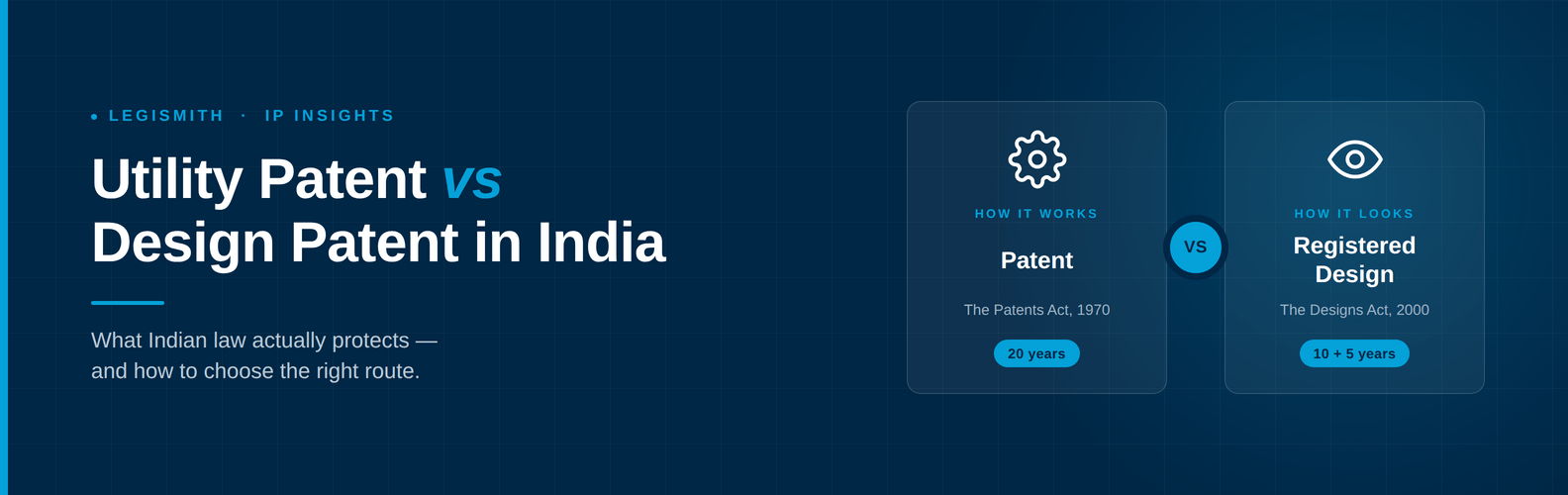
India protects the way a product works through a patent. It protects the way a product looks through a registered design. Two separate rights, two separate Acts, different terms and fees.
At Legismith LLP, we see this confusion cost inventors real money. A designer discloses a product too early and loses the right to register it. A start-up files one application when it needed two. This guide explains what Indian law actually offers.
Utility Patent vs Design Patent: What India Actually Calls Them
The words “utility patent” and “design patent” come from the United States. Indian law uses different terms for the same ideas.
American term | Indian equivalent | Governing law |
Utility patent | Patent | The Patents Act, 1970 |
Design patent | Registered design | The Designs Act, 2000 |
Utility model | Not available in India | Under policy discussion only |
In India, every patent is what an American lawyer would call a utility patent. There is no separate category. So when you read “file a design patent in India”, read it as “apply to register a design”.
The distinction itself is simple. The United States Patent and Trademark Office manual puts it neatly: one protects the way an article is used and works, the other protects the way it looks.
What a Patent Protects in India
A patent protects function. It covers a product or a process that solves a technical problem in a new way.
To qualify, your invention must clear three tests under the Patents Act, 1970:
- Novelty — it must not already be known anywhere in the world.
- Inventive step — it must not be obvious to a skilled person in that field.
- Industrial application — it must be capable of being made or used in industry.
Examples include a faster-charging battery cell, a new manufacturing process, or a chemical formulation. If your product’s value lies in what it does, this is your route.
A patent lasts 20 years from the filing date. Renewal fees begin from the third year and continue annually. Miss them, and the patent lapses.
Secure Your Patent in India.
Learn about the statutory requirements and process for patent filing. Navigate complex legal frameworks with architectural precision and transparency.
What a Registered Design Protects in India
A registered design protects appearance. Section 2(d) of the Designs Act, 2000 covers features of shape, configuration, pattern, ornament, or composition of lines or colours applied to an article.
One phrase does most of the work: the design must be judged solely by the eye. No technical expert is needed, and functional merit is not considered.
Think of a distinctive bottle silhouette, a saree border pattern, or a chair profile.
What cannot be registered as a design
According to the official guidance from IP India, a design will be refused if it:
- is not new or original;
- has already been published in India or elsewhere;
- cannot be distinguished from a known design;
- is dictated solely by function or mechanical construction;
- is really a trade mark, property mark, or artistic work; or
- is obscene or scandalous.
That fourth point catches many applicants. If a shape exists only because the product could not work otherwise, it is not a design. Function belongs to the patent system.
A registered design lasts 10 years from registration. You may extend it once, by 5 years, but only if you apply before the first term expires. The maximum is 15 years.
Careful here: American articles quote a flat 15-year design term with no renewal. In India, those five extra years are not automatic. You must apply for them in time.
What are the official fees?
Both systems charge a lower fee to individuals, start-ups and small entities. The figures below are indicative, and you should always confirm the current schedule on the IP India portal before filing.
Filing | Natural person, start-up or small entity | Other applicants |
Patent application (e-filing) | ₹1,600 | ₹8,000 |
Request for examination | ₹4,000 | ₹20,000 |
Design application | ₹1,000 | ₹4,000 |
Design renewal | ₹2,000 | ₹8,000 |
Design registration is clearly the lighter route on cost and time. That does not make it the weaker one, as the next section shows.
Can You Protect the Same Product Both Ways?
Yes. The two rights are separate, and one product can carry both.
Wireless earphones are a useful example. The charging circuit and the connection method sit in patents. The shape of the earbud and the case sit in design registrations. Same product, two files.
Design rights are not a consolation prize either. In the long-running Apple and Samsung dispute in the United States, a 2018 jury award of roughly $539 million rested largely on design rights.
Indian courts have also strengthened the position of design owners. In Crocs Inc. USA v. Bata India, decided on 01/07/2025, the Delhi High Court confirmed that a registered design owner may also bring a passing-off action.
If you are weighing what these assets are worth, our explainer on understanding IP valuation walks through the common methods.
The Overlap Most People Miss: Section 15(2) of the Copyright Act
This is the trap that catches designers most often, and almost no article mentions it.
Your drawings enjoy copyright automatically. But Section 15(2) of the Copyright Act, 1957 says copyright in a design which could have been registered under the Designs Act, but was not, ends once the article has been reproduced more than fifty times by an industrial process.
Read that again if you make physical products. Once your fifty-first unit rolls off the line, an unregistered design may have no protection at all — not under design law, and no longer under copyright.
Common Mistakes When Choosing Between the Two
- Showing the product before filing. Prior publication destroys novelty. A trade fair stall, an online post, or a launch video can end your right to register.
- Expecting a design to cover function. It never will. A competitor may copy the mechanism freely if you only hold a design registration.
- Expecting a patent to stop visual copying. A rival can design around your look while respecting your claims.
- Applying US timelines to Indian filings. The 10+5 structure and the six-month design priority window are specific to India.
- Missing the design extension deadline. There is no second chance after expiry.
It is also worth checking that your own product does not infringe someone else’s rights. Our guide to freedom to operate analysis explains why that check belongs early in development, not after tooling is paid for.
Is a Utility Model Available in India?
No. India has no utility model, sometimes called a petty patent, which protects smaller incremental improvements at a lower threshold.
The idea appeared in the draft National IPR Policy in 2015 but was dropped from the final version. It has returned to discussion since, including at the Economic Advisory Council to the Prime Minister in 2023. For now, it remains a proposal.
So if your improvement is modest, your realistic options are a patent, a design registration, or keeping the know-how confidential.
What May Change in Indian Design Law
Design filings in India are growing quickly. Applications reached 43,005 in 2024–25, a rise of about 41% in a single year, according to the annual report published by IP India. Figures from the World Intellectual Property Organization’s 2025 indicators show India recorded the fastest design growth of any major filing origin.
The law is being reviewed to keep pace. A concept note published by DPIIT in January 2026 sets out proposals including:
- express protection for graphical user interfaces, icons and animations;
- a blanket 12-month grace period for disclosure;
- deferred publication of up to 30 months;
- statutory damages of up to ₹50 lakh for wilful infringement;
- a revised 5+5+5 year term structure; and
- accession to the Hague Agreement for international design filing.
These are proposals, not law. Nothing here changes your current position, but the direction of travel is worth watching if you are planning a multi-year product roadmap.
Final Thoughts on Choosing the Right Protection
The choice between a utility patent vs design patent is really a question about your own product. Ask yourself where the value sits.
If a customer buys because of what your product does, look at the patent route under the Patents Act, 1970. If they buy because of how it looks, look at design registration under the Designs Act, 2000. If both are true, file both — and file before you show anyone.
At Legismith LLP, we work across both systems. You can read more on our patent services page or our industrial design page. If your product’s shape has also become recognisable to buyers, our guide to trademark registration in India covers what happens after design protection ends.
So, which matters more to your product’s value in the market — how it works, or how it looks? If you are unsure, that is usually a sign your product deserves a closer look at both. You are welcome to get in touch with our team to talk it through.
Patent Fee Calculator
Calculate official Indian patent fees instantly — filing, examination, renewals, oppositions, PCT and more. DPIIT startup rates included. Based on the First Schedule of the Patents Rules.

Disclaimer
The content provided in this article is for general informational purposes only and does not constitute legal advice. Please consult with a qualified IP attorney for your specific needs.