
You have a prototype, a rough sketch and a filing date in mind. Many first-time applicants scan that sketch, attach it to the application and move on. Then the examination report arrives and the drawings have to be redone, sometimes along with the claims that refer to them.
Patent drawings in India follow a short, specific set of rules: section 10 of the Patents Act, 1970 and Rules 13 and 15 of the Patents Rules, 2003. This guide explains what each rule asks for, when drawings are needed, how they tie into your claims, what they cost and the mistakes that lead to objections. At Legismith LLP, we treat drawings as part of the specification itself, because in law that is exactly what they are. The rules below are stated as of 18/11/2026.
What is a patent drawing, and is it mandatory in India?
A patent drawing is a figure filed with the specification to show how an invention is built or how it works. Under section 10(2) of the Patents Act, 1970, drawings are optional unless the invention needs them to be understood, or the Controller asks for them. Once filed, they are treated as part of the specification.
That last point matters more than it first appears. Because drawings are deemed part of the specification (section 10(2)), they carry the same weight as the description and claims, and they count towards the same page limits and fees.
In practice, mechanical, electrical and electronic inventions almost always need drawings, and so do most process and software inventions, which are usually shown as flowcharts or block diagrams. A new chemical composition can often be described fully in words and formulae.
Drawings are also different from a model. Under section 10(3), the Controller may ask for a model or sample of the invention before grant, but unlike a drawing, a model never becomes part of the specification.
For where drawings sit among the other parts of an application, see our complete guide to patent filing in India.
What format does Rule 15 require for patent drawings?
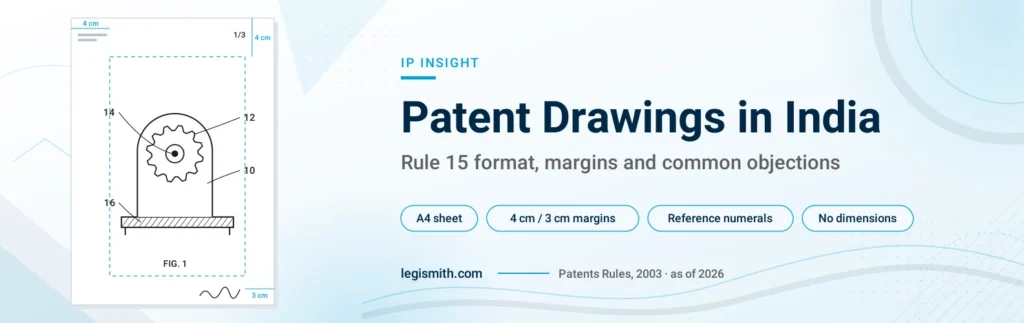
Rule 15 asks for neat, clear drawings on durable A4 sheets, with margins of at least 4 cm at the top and left and 3 cm at the bottom and right. Each sheet carries the applicant’s name, the sheet number and total, and a signature. Dimensions are not marked, and text is allowed only in flow diagrams.
Here is each part of Rule 15 of the Patents Rules, 2003 in plain language, with a common mistake against each.
| Rule | What it requires | Common mistake |
|---|---|---|
| 15(1) | Drawings go with the specification they relate to | Treating drawings as a separate document to send later |
| 15(2) | No drawing or sketch inside the description itself | Pasting figures into the description pages |
| 15(3) | At least one neat, clear copy on durable paper | Filing a faint scan or phone photo of a hand sketch |
| 15(4) | A4 sheets; margins of at least 4 cm top and left, 3 cm bottom and right | Using PCT or US margins, which are narrower |
| 15(5) | A scale large enough to show the invention clearly; no dimensions marked | Exporting CAD drawings with measurements still on them |
| 15(6) | Sheets numbered in order; applicant’s name top left; sheet number and total sheets top right; signature of the applicant or agent bottom right | Leaving out the signature or the sheet count |
| 15(7) | No descriptive matter except in flow diagrams | Writing labels such as “motor” on a mechanical figure instead of using reference numerals |
Rule 15(7) is short enough to quote in full: “No descriptive matter shall appear on the drawings except in the flow diagrams.” A flowchart is the one kind of drawing that may carry words.
Three beliefs worth dropping
- “Drawings must be to scale.” Rule 15(5) asks only for a scale large enough to show the invention clearly, and it forbids marking dimensions.
- “Frames and photographs are banned.” Rule 15 does not say so, and nor does IP India’s draft Manual of Patent Practice and Procedure, version 4.0 (2026). Line drawings remain the practical choice because they reproduce cleanly.
- “PCT drawings can be filed in India as they are.” Not if the margins are PCT margins. See the comparison table below.
How do drawings connect to the description, claims and abstract?
Drawings must match the words. Rule 13(4) requires them to be referred to in detail in the specification, and features shown in a drawing must carry their reference signs, in brackets, in the claims. Rule 13(7)(d) also asks you to name the figure that should be published with the abstract.
This link between figures and text is where many drafts slip, and no amount of drawing polish fixes it. Before filing, check four things against Rule 13 and the draft practice manual:
- Brief description of the drawings. The description lists every figure, for example “Figure 1 is a side view of the device”.
- Every numeral is explained. Each reference numeral in a figure is described in the text, and the same part keeps the same numeral in every figure.
- Claims carry the signs. A claim might read “a housing (10) holding a sensor (12)”. The numbers in brackets point the examiner to the figure.
- The abstract names a figure. Indicate the figure to be published with the abstract, and add its reference signs to the main features mentioned there.
For software and computer-implemented inventions, flowcharts and block diagrams do most of this work, which is why Rule 15(7) lets them carry short text. Our patent registration page explains how section 3(k) affects software filings.
Do you need drawings with a provisional patent application?
Not always. Section 10(2) applies to provisional and complete specifications alike, so drawings are needed only when the invention cannot be understood without them. If you do file drawings with a provisional, Rule 13(4) lets the complete specification adopt them by reference instead of filing them again.
A provisional application secures an early filing date while you finish the invention, and the complete specification must follow within 12 months. Our provisional patent application guide covers that timeline in detail.
The catch is detail. A provisional with one rough sketch may not support the complete specification you file later, because matter that first appears in the complete specification may not enjoy the provisional’s earlier date. So if a figure explains how the invention works, it is usually safer to include it at the provisional stage, even in simple form, than to add it later.
Startups and first-time filers weighing a provisional against a complete application can compare both in our patent filing guide for startups.
If you are preparing a provisional and are unsure how much the drawings need to show, schedule a call with our team to discuss drafting your specification. Learn how we approach patent drafting.
Have questions about protecting a new product, brand or design? Talk them through with our IP team.
Schedule a call →How do Indian drawing rules differ from PCT and US rules?
India asks for wider margins than the PCT and the US. Indian drawing sheets need at least 4 cm at the top and left and 3 cm at the bottom and right, while PCT and US sheets need 2.5 cm, 2.5 cm, 1.5 cm and 1 cm. Sheets prepared for those systems should be reformatted before filing in India.
| Requirement | India (Rule 15) | PCT (Rule 11) | US (37 CFR 1.84) |
|---|---|---|---|
| Sheet size | A4 | A4 | A4 or 8.5 × 11 inches |
| Minimum margins (top / left / right / bottom) | 4 / 4 / 3 / 3 cm | 2.5 / 2.5 / 1.5 / 1 cm | 2.5 / 2.5 / 1.5 / 1 cm |
| Frames around the drawing | Not addressed in Rule 15 | Not allowed | Not allowed |
| Words on drawings | Only in flow diagrams | A few short catchwords where indispensable | Excessive text is objected to |
For an international application entering India, section 10(4A) treats the drawings filed with it as part of the complete specification, but what you file in India still needs to meet Indian format. Our guides to PCT filing from India and national phase entry explain the wider process.
What objections do examiners raise on patent drawings?
Most drawing objections trace back to Rule 15 or Rule 13: wrong margins; a missing name, sheet count or signature; text on figures that are not flowcharts; dimensions left on CAD exports; or reference numerals that do not appear in the description and claims. Each can be caught with a check before filing.
| Issue | Rule | How to avoid it |
|---|---|---|
| Margins narrower than 4 cm / 3 cm | 15(4) | Set an Indian A4 template before drawing |
| No applicant name, sheet count or signature | 15(6) | Add all three to every sheet, including the last |
| Labels or notes on mechanical figures | 15(7) | Replace words with reference numerals |
| Dimensions shown | 15(5) | Hide dimension layers before export |
| Numerals missing from the text or claims | 13(4) | Cross-check every numeral against the description and claims |
| Figure not described | 13(4) | List every figure in the brief description of drawings |
If an objection does arrive, drawings can be corrected in the reply, within the limit that no new matter is added. Our guide to the patent granting procedure explains where the First Examination Report fits.
Work out official Indian patent fees for your application, based on the First Schedule of the Patents Rules.
How much do patent drawings cost in India?
The Patent Office charges no separate fee for drawings. Because drawings form part of the specification, their sheets count towards the 30 sheets covered by the filing fee, and each sheet beyond 30 adds a fee. What an illustrator or patent agent charges to prepare drawings varies and is agreed separately.
Government fees under the First Schedule to the Patents Rules, for e-filing, as of 18/11/2026:
| Item | Natural person, startup, small entity or educational institution | Others |
|---|---|---|
| Application (Form 1), up to 30 sheets and 10 claims | ₹1,600 | ₹8,000 |
| Each sheet of specification beyond 30 | ₹160 | ₹800 |
Note on fees: The government fees above are taken from the official First Schedule to the Patents Rules, 2003, published by IP India, and are correct as of 18/11/2026. Fees can change when the Rules are amended, so check the current First Schedule on the IP India website before you file.
A quick example: a 26-page specification with 8 sheets of drawings comes to 34 sheets. That is 4 sheets over the limit, or ₹640 extra for an individual filer and ₹3,200 for a company that is not a small entity. Paper filing costs more than e-filing.
These are government fees only. Professional fees for drafting and drawings are separate. To estimate the full official cost of a filing, try our patent fee calculator, and see our e-filing guide for where the sheet count is entered.
Work out official Indian trademark fees for your application, based on the First Schedule of the Trade Marks Rules, 2017.
Frequently Asked Questions
Can I file photographs instead of patent drawings in India?
Rule 15 does not mention photographs, and neither does IP India's draft practice manual of 2026. It asks for neat, clear drawings on durable paper with no descriptive matter. Line drawings reproduce reliably in the patent record, so most applicants use them. If a photograph seems the only way to show your invention, check with your patent agent first.
Can AI or software make patent drawings?
Yes. The rules do not prescribe a tool, so CAD software, vector drawing programs and AI tools can all produce figures. What matters is the output: Rule 15 format, reference numerals that match the description and claims, and no dimensions. You remain responsible for every drawing filed in your name, so check each figure before filing.
Can I add or change drawings after filing?
The Controller can ask for drawings at any stage under section 10(2). You can also amend drawings, for example in reply to the First Examination Report, but an amendment cannot bring in matter that the specification did not disclose or show when it was filed. A new figure showing new features is therefore risky.
How many drawings should a patent application have?
There is no fixed number. Include as many figures as you need to show every feature you claim, such as overall views, sections, exploded views or flowcharts. Each figure adds to the sheet count, and sheets beyond 30 attract an extra fee, so leave out duplicate or decorative views.
Where can I find drawings of existing patents?
Published Indian applications and granted patents, with their drawings, can be viewed on IP India's public search system using an application number or keywords. Studying granted patents in your field shows how drawings for similar inventions were accepted. Our guide to Indian patent search by application number explains the steps.
Before You File: A Patent Drawing Checklist
Good drawings are less about artistic skill than about matching a short list of rules. Before you file, run through these points:
- A4 sheets with margins of at least 4 cm top and left, 3 cm bottom and right
- Applicant’s name top left, “sheet x of y” top right, signature bottom right
- No dimensions, and no words except in flowcharts
- Every figure listed in the brief description of drawings
- Every reference numeral explained in the text and used consistently
- Reference signs in brackets in the claims
- The figure for the abstract indicated
- Provisional drawings detailed enough to support the complete specification
- PCT or foreign drawings reformatted to Indian margins
- Total sheets counted for the fee
Which of these would your current drawings miss? If you would like a second look at your drawings and specification before filing, schedule a call with the team at Legismith LLP through our patent registration page.
The content provided in this article is for general informational purposes only and does not constitute legal advice. Please consult with a qualified IP attorney for your specific needs.