
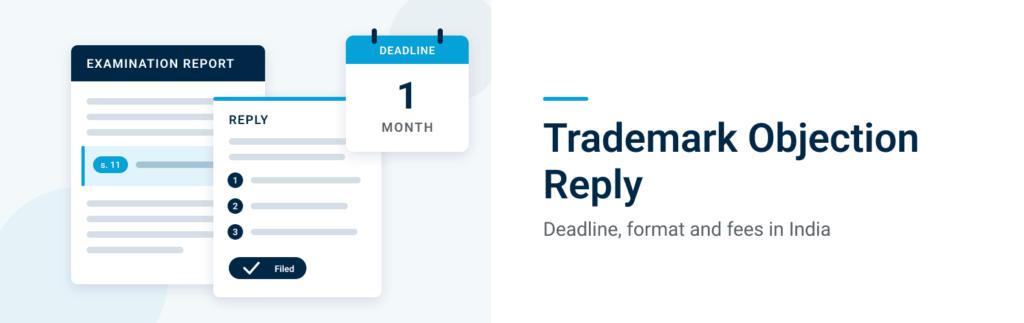
The email from the Trade Marks Registry looks routine until you open the attachment: an examination report listing objections to the brand name you filed months ago. How long do you have, what do you write, and what will it cost?
A trademark objection reply is your written answer to that examination report. Under the Trade Marks Rules, 2017, you have one month from the date you receive the report to file it, and IP India lists no government fee for the reply itself. This guide from Legismith LLP explains how to read the report, how to answer Section 9 and Section 11 objections, what happens at a hearing and what to do if a date slips. It covers the examination stage of the trademark registration process.
Key numbers (as of 23/11/2026)
| What | The rule | Source |
|---|---|---|
| Deadline to reply | One month from the date you receive the examination report | Rule 33(4) |
| Report sent by email | Counts as served at the time it is sent | Rule 18(2) |
| Extension of time | Up to one month, on Form TM-M, at the Registrar’s discretion | Rule 109 |
| Government fee for the reply | None listed | IP India fee schedule |
| Form TM-M fee | ₹900 e-filing / ₹1,000 physical | IP India fee schedule |
| Written grounds after a refusal | Ask on Form TM-M within 30 days | Rule 36(1) |
| Appeal against a refusal | To the High Court, within three months | Section 91(1) |
IP India does not publish a figure for how often applications receive objections, or for how long a decision takes after a reply. Treat any such figure you read elsewhere with care.
What is a trademark objection, and how do you read your examination report?
A trademark objection is the examiner’s reason, set out in the examination report, for not accepting your application yet. It is not a refusal. The report names each objection and the section of the Trade Marks Act, 1999 behind it, and you answer it in writing before the Registrar decides.
The report reaches you at the address for service on your application, which under Rule 17(1) must include an email address. It is worth reading in this order:
- Application details. Number, mark, class and applicant. Check they match what you filed.
- Each objection and its section. Section 9 objections are about the mark itself; Section 11 objections are about earlier marks.
- Cited marks. For Section 11, the earlier marks the examiner considers similar, with their numbers and classes.
- Other requirements. For example, a clearer description of goods or services, or a missing document.
Objection, opposition or refusal?
| Who raises it | When | What you file | |
|---|---|---|---|
| Objection | The examiner, for the Registrar | After filing, in the examination report | A written reply within one month (Rule 33(4)) |
| Opposition | Any person | Within four months of the mark’s advertisement in the Trade Marks Journal (section 21(1)) | A counter-statement within two months of receiving the notice (section 21(2)) |
| Refusal | The Registrar | After the reply and any hearing | A request for written grounds within 30 days (Rule 36(1)), then an appeal to the High Court |
How long do you have to reply to a trademark objection?
You have one month from the date you receive the examination report, under Rule 33(4) of the Trade Marks Rules, 2017. If no reply is filed, the Registrar may treat the application as abandoned. Because an emailed report counts as served when it is sent, the clock usually starts on the date of the email.
Many guides say “30 days”. The rule says one month, counted from receipt, and Rule 18(2) treats an email as served at the time it is sent. What counts is the date on the Registry’s email, not the day you opened it.
If you genuinely need more time, Rule 109 lets you apply on Form TM-M for an extension of up to one month. The Registrar grants it only “if satisfied that the circumstances are such as to justify the extension”. It is a safety net, not a plan.
What are Section 9 and Section 11 objections, and how do you answer each?
Section 9 objections concern the mark itself, for example that it describes the goods or lacks distinctive character. Section 11 objections concern earlier marks that the examiner thinks are identical or similar, for similar goods or services. Each needs a reply that answers the specific ground, with evidence where it helps.
Section 9: the mark itself
A Section 9 objection usually says the mark describes the product or cannot tell your goods apart from others. A reply explains why the mark, taken as a whole, is not descriptive for the goods or services listed. Where you have used the mark before filing, the proviso to section 9(1) of the Trade Marks Act, 1999 allows evidence that the mark has become distinctive through use, so invoices, advertising and sales figures from before the filing date can matter.
Section 11: earlier marks
A Section 11 objection cites one or more earlier marks. A good reply compares your mark with each cited mark on the points below, rather than simply saying the two are different.
| Point to compare | What to look at |
|---|---|
| Look | Spelling, design, colours and the overall impression |
| Sound | How each mark is spoken, including in regional languages where it is sold |
| Meaning | Whether the words share an idea or a meaning |
| Goods and services | Whether the classes and descriptions really overlap |
| Customers and trade channels | Who buys each product, and where |
| Status of the cited mark | Whether it is registered, pending, abandoned or removed |
You can check the cited marks yourself on IP India’s public search; our guide on how to search the trademark register shows how. Whether a difference is enough is for the examiner to judge on the facts.
Objections about class or wording
Some objections are not about the mark at all, but about a vague or misplaced description of goods or services. These can often be resolved by amending the description on Form TM-M. Our trademark class finder helps you find the right class and standard wording.
How do you write and file a trademark objection reply?
Answer every objection in the report, point by point, in a reply filed online against your application number. Give the legal ground for each answer, attach evidence such as invoices or advertising where it supports your case, and ask the Registrar to accept the application or give you a hearing.
A clear reply usually has five parts:
- Application details. Application number, mark, class, applicant and the date of the report, so the reply is matched to the right file.
- A point-by-point answer. One heading for each objection, in the order of the report. A point left unanswered is the easiest one for the examiner to keep.
- Legal submissions. The section you rely on, and why the objection does not apply on your facts.
- Evidence. Indexed annexures, such as invoices, advertising, sales figures or an affidavit of use. Evidence should match the date of first use claimed in your application.
- A request. Ask the Registrar to withdraw the objections and accept the application for advertisement or, failing that, to give you a hearing under Rule 33(6).
The reply is filed online through IP India’s comprehensive e-filing services. Keep the acknowledgement and a copy of everything you file; that record is your proof if the status is ever questioned.
Have questions about protecting a new product, brand or design? Talk them through with our IP team.
Schedule a call →What does a trademark objection reply cost?
IP India’s fee schedule lists no government fee for filing a reply to an examination report. You pay ₹900 (e-filing) or ₹1,000 (physical) on Form TM-M only if you need an extension of time, the written grounds of a decision or an amendment. Professional fees for drafting are separate.
Government fees under the First Schedule to the Trade Marks Rules, 2017, from IP India’s Forms and Official Fees page, as of 23/11/2026. Entry 7 lists one fee for every applicant category.
| Item | Form | E-filing | Physical filing |
|---|---|---|---|
| Reply to the examination report | — | No fee listed | No fee listed |
| Extension of time | TM-M | ₹900 | ₹1,000 |
| Written grounds of the Registrar’s decision | TM-M | ₹900 | ₹1,000 |
| Amendment of the application | TM-M | ₹900 | ₹1,000 |
Professional fees for drafting a reply are separate and depend on the work involved. For the full schedule, including filing and renewal, see our trademark fees guide.
What happens after you reply?
If the examiner accepts the reply, the application is advertised in the Trade Marks Journal, and anyone may oppose it within four months. If the examiner is not satisfied, the Registrar gives you a hearing, which can be held by video conference. IP India publishes no standard timeline for a decision.
Applicants often call this a “show cause hearing”. Under Rule 33(6), it is the hearing the Registrar gives before deciding on an application, and Rule 115(1) allows it to be held by video conference, treated as held at the appropriate office. For a business in Pune, that office is the Trade Marks Registry in Mumbai, which handles Maharashtra, Madhya Pradesh, Chhattisgarh and Goa based on the applicant’s principal place of business.
Opposition after advertisement (section 21(1)) is a separate procedure with its own deadlines. Our guide for Pune applicants covers the registry and who can act for you.
What if you miss the deadline or your mark is refused?
If you miss the one-month deadline, the Registrar may treat the application as abandoned under Rule 33(4). If the application is refused after a reply and hearing, you can ask for the written grounds on Form TM-M within 30 days and then appeal to the High Court within three months.
| Situation | What the law says | What it means for you |
|---|---|---|
| No reply within one month | The Registrar may treat the application as abandoned (Rule 33(4)) | “May” leaves the decision to the Registrar. Do not rely on it; reply or apply for an extension before the date passes. |
| You replied, but missed the hearing | Rule 33(7) deals with abandonment where the applicant has not replied and does not appear at the hearing | Your reply stays on record, but you lose the chance to argue it. Attend, by video if that is easier. |
| The application is refused | Ask for written grounds on Form TM-M within 30 days (Rule 36(1)); appeal to the High Court within three months of the decision (section 91(1)) | Note both dates as soon as the order arrives. |
A recent example
In P.G. Purushan v. Registrar of Trade Marks (CMA(TM) No. 14 of 2025, decided on 11/12/2025), the Madras High Court set aside an order treating the application for the mark STIMULAID as abandoned. The applicant’s reply to the examination report was on record, and the court noted that the applicant “had submitted Form TM-M and had also subsequently attended the hearing”. The lesson is practical: file on time, keep every acknowledgement, and attend the hearing.
Work out official Indian trademark fees for your application, based on the First Schedule of the Trade Marks Rules, 2017.
Frequently Asked Questions
How to remove objections in trademark?
An objection is removed when the examiner accepts your reply, or after a hearing. File a written reply within one month of receiving the examination report, answer every ground it raises, and attach evidence where it helps. Some objections, such as an unclear description of goods or services, can also be cleared by amending the application on Form TM-M.
How to check trademark objection?
Read the examination report sent to the email address on your application, and check the application’s status on IP India’s online trade mark status service using your application number. The report lists each objection, the section of the Trade Marks Act it relies on and any earlier marks cited against yours.
Can a lawyer do trademark registration?
Yes. Under section 145 of the Trade Marks Act, 1999, an applicant can act personally or through an agent: a legal practitioner, a registered trade marks agent, or a person in the applicant’s sole and regular employment. That covers filing the application, replying to the examination report and appearing at the hearing.
How much is the government fee for a trademark?
IP India lists no government fee for replying to an examination report. A new trademark application carries a class fee that depends on the applicant category, and Form TM-M costs ₹900 when e-filed, for example to ask for an extension of time. Our trademark fee guide sets out the full schedule.
Final Thoughts on Replying to a Trademark Objection
Three things decide most replies: the date, the detail and the hearing. Count one month from the date the Registry’s email was sent. Answer every point in the report, with evidence wherever your argument depends on use. And if a hearing is fixed, attend it, by video if that is easier.
If you would like the team at Legismith LLP to look over your examination report before you reply, you can schedule a call through our trademark page.
The content provided in this article is for general informational purposes only and does not constitute legal advice. Please consult with a qualified IP attorney for your specific needs.