
Your drawings are ready. The form is filled in. Then you reach the box asking for a class number, and everything stops.
That number comes from the Locarno Classification, the international system that sorts products into 32 groups for the purpose of design registration. Get it right and the application moves on. Get it wrong and you are looking at an objection, a delay, sometimes a fresh filing.
More people are running into this than before. The Indian IP office received 43,005 design applications in 2024-25, which is 41.52% up on the year before. Roughly nine out of every ten came from Indian applicants.
So here is how the system actually works, and how you find your class.
What is the Locarno Classification?
Think of it as a shared filing language for design offices.
Without one, the same chair would sit in a different drawer in every country, and searching for earlier designs across borders would be close to impossible.
The system came out of the Locarno Agreement, signed in the Swiss town of Locarno on 08/10/1968. It took effect on 27/04/1971. WIPO has run it ever since.
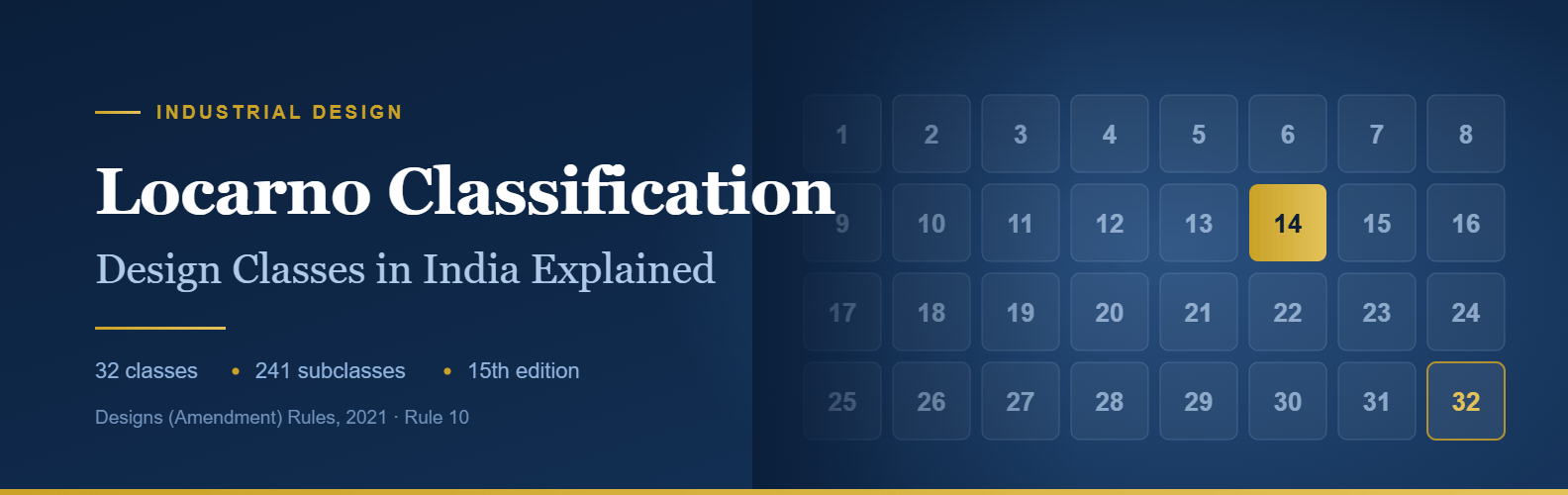
The 15th edition has been in force since 01/01/2025. It holds 32 classes and 241 subclasses, along with an alphabetical list of more than 5,000 goods, each one tagged with its class and subclass. All of it is free to browse on WIPO’s Locarno publication database.
How India Came to Adopt the Locarno Classification
India signed up on 07/06/2019, as the 57th member.
Before that we had our own arrangement: 31 classes plus a catch-all Class 99. It had been lifted from the 10th edition of Locarno back in 2008, at a point when India was not even a member. Over the years it drifted out of step with everyone else.
The Designs (Amendment) Rules, 2021 fixed that on 25/01/2021. Rule 10 of the Designs Rules, 2001 was replaced, and articles are now classified under whichever edition of the Locarno Classification happens to be current. The amended Rules sit on the Designs Rules page at IP India.
That wording matters more than it looks. Because Rule 10 points at the current edition rather than a named one, India picks up each new edition automatically. Nothing needs to be amended here.
One more thing worth clearing up. Class 99 no longer exists as a class in its own right. Locarno puts a “-99” subclass inside each class instead, for items that fit nowhere else. So you will see 06-99, or 12-99. A surprising number of articles online still get this wrong.
Protect Your Product's Design.
Stop copycats. File your design patent quickly and affordably. Secure the aesthetic identity that defines your brand’s authority.
The 32 Locarno Design Classes
Class | Heading |
1 | Foodstuffs |
2 | Articles of clothing and haberdashery |
3 | Travel goods, cases, parasols and personal belongings |
4 | Brushware |
5 | Textile piece goods, artificial and natural sheet material |
6 | Furnishing |
7 | Household goods, not elsewhere specified |
8 | Tools and hardware |
9 | Packagings and containers for the transport or handling of goods |
10 | Clocks, watches and other measuring, checking and signalling instruments |
11 | Articles of adornment |
12 | Means of transport or hoisting |
13 | Equipment for production, distribution or transformation of electricity |
14 | Recording, telecommunication or data processing equipment |
15 | Machines, not elsewhere specified |
16 | Photographic, cinematographic and optical apparatus |
17 | Musical instruments |
18 | Printing and office machinery |
19 | Stationery and office equipment, artists’ and teaching materials |
20 | Sales and advertising equipment, signs |
21 | Games, toys, tents and sports goods |
22 | Arms, pyrotechnic articles, articles for hunting, fishing and pest killing |
23 | Fluid distribution, sanitary, heating, ventilation and air-conditioning equipment, solid fuel |
24 | Medical and laboratory equipment |
25 | Building units and construction elements |
26 | Lighting apparatus |
27 | Tobacco and smokers’ supplies |
28 | Pharmaceutical and cosmetic products, toilet articles and apparatus |
29 | Devices and equipment against fire hazards, for accident prevention and for rescue |
30 | Articles for the care and handling of animals |
31 | Machines and appliances for preparing food or drink |
32 | Graphic symbols and logos, surface patterns, ornamentation |
Class 32 is the one Indian applicants had never dealt with before. Graphic symbols, logos, surface patterns, ornamentation. In practice it has also been used for interior arrangements, the inside of a room or a shop, for example.
Classes and Subclasses: How the Numbering Works
Classes are only the top layer. Each one breaks into subclasses, written as two numbers with a hyphen between them.
Class 14 is a useful one to look at. It covers recording, telecommunication and data processing equipment:
- 14-01 Equipment for recording or reproducing sound or pictures
- 14-02 Data processing equipment and peripherals
- 14-03 Telecommunications equipment and remote controls
- 14-04 Screen displays and icons
- 14-05 Recording and data storage media
- 14-99 Miscellaneous
You file against the subclass, not the class on its own. A laptop belongs in 14-02. An icon on that laptop’s screen belongs in 14-04. Same class, quite different subclass.
How to Find Your Locarno Class
Write down what the article actually is –
Plain words, not marketing words. “Insulated water bottle” will get you somewhere. “Hydration solution” will not.
Search the alphabetical list.
Open the WIPO Locarno database and type in the product name. For anything reasonably common, this alone hands you a class and subclass. Start here before you start guessing.
Read the notes –
Every class carries explanatory notes setting out what is in and what is out. Most borderline questions get settled right there. Class 7, for instance, specifically pushes machines for preparing food or drink over to Class 31.
Follow function, not material –
Locarno sorts by what a thing is for. A steel chair and a plastic chair both sit in Class 6. What it is made of makes no difference at all.
Look at what similar products did –
Run a search on the Indian design search facility or the WIPO Global Design Database. If everyone in your sector files under one subclass, that tells you something useful.
Check which version applies –
The product list gets updated on its own schedule, separately from the edition. Version 2026_LOC15 came in on 01/01/2026 and covers applications filed from that date, even though the class structure of the 15th edition did not move.
Where People Usually Go Wrong
A few patterns come up again and again.
Sorting by material is the big one. It feels intuitive, and it is wrong almost every time.
Class 7 and Class 31 catch people constantly. Hand-operated kitchen items sit in Class 7. Powered machines for preparing food or drink sit in Class 31. There is a reported case of a kitchen appliance filed under Class 31 when Class 7 was the right home, and the application drifted between departments for months before it was properly examined.
Exclusion notes get skipped. Car mats go into 06-11 with the carpets, not into Class 12 with the vehicles, even though you would only ever use them in a car.
Then there is the assumption that a single application can stretch across several classes. It cannot. One design, one article, and fees run per design and per class. The current schedule is on the IP India designs page.
Getting the Class Right Does Not Mean You Get the Registration
Worth saying plainly, because it catches people out.
Classification is administration. It helps the office sort, file and search. It does not hand you a right.
Your design still has to clear the Designs Act, 2000. Section 2(a) sets out what counts as an “article”. Section 2(d) sets out what counts as a “design”. It must be new or original, applied to an article by an industrial process, and judged by the eye alone.
Designs on Screens: Class 14-04 and Class 32
This has been the most argued-over corner of Indian design practice.
For years the Designs Office refused these applications. The reasoning was that a graphical user interface only appears once the device is switched on, so it is never really applied to the article at all.
That has now shifted. In an order dated 09/02/2026, the Calcutta High Court held that GUIs can qualify as designs. There is no permanence requirement anywhere in Section 2(d), the Court found, and “industrial process” has to be read in a way that does not shut out newer technology. The Court also made the point that adopting Locarno guarantees nothing by itself, though it does signal an intention to make room for digital designs.
If your product has a screen, this is one to watch. Our note on AI and IP rights in India picks up some of the related questions.
Locarno Classification or NICE Classification?
These two get mixed up constantly.
Locarno Classification | NICE Classification | |
Used for | Industrial designs | Trademarks |
Established | 1968 | 1957 |
Number of classes | 32 | 45 |
Protects | Appearance of an article | Brand identity for goods and services |
A single product often involves both. The shape of a bottle can be registered as a design under Locarno, while the brand name printed on its label is a trademark under NICE. Our guide to the NICE Classification for trademark registration in India covers that second system properly, and the complete guide to trademark registration in India walks through the filing process.
Where the design is also an original artistic work, the Copyright Act, 1957 may come into play alongside design protection.
Trademark Class Finder
Describe your business and get the likely NICE classes, plus goods and services wording in accepted-term language.

What Happens in 2027
WIPO published an advance version of the Locarno Classification 16th edition on 26/02/2026. It comes into force on 01/01/2027.
Rule 10 takes care of the rest. Anything filed in India from that date is classified under the 16th edition, with no Indian amendment needed. If you have filings planned on either side of that line, it is worth checking whether your subclass has moved. Changes get posted on the WIPO Locarno news page.
One Last Thought
Classification feels like paperwork. It is not, quite.
It decides how your design gets searched, how it gets examined, and what it eventually gets compared against if someone copies it. Ten minutes of care now tends to save months later.
Which class does your product fall into, and what made it a difficult call?
Disclaimer
The content provided in this article is for general informational purposes only and does not constitute legal advice. Please consult with a qualified IP attorney for your specific needs.