
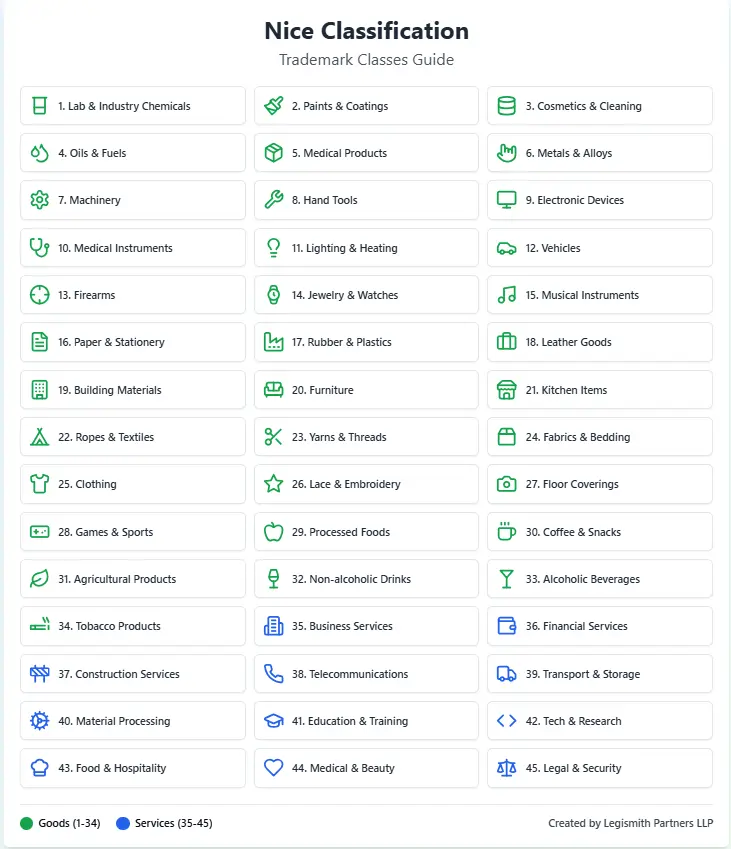
The NICE Classification is a cornerstone of global trademark registration, providing a standardized system to categorize goods and services. For businesses in India and beyond, understanding this framework is critical to protecting intellectual property effectively. In this article I have summarized a concise overview of NICE Classification history, key facts, and relevance for Indian trademark applicants.
History of the NICE Classification
The NICE Classification was established by the Nice Agreement on June 15, 1957, during a diplomatic conference in Nice, France. It became operational on April 8, 1961, initially comprising 34 classes for goods and 8 classes for services (totaling 42 classes). Over time, the system evolved to reflect market changes and technological advancements. Today, it includes 45 classes (34 for goods, 11 for services), with the 12th edition effective from January 1, 2023.
Administered by the World Intellectual Property Organization (WIPO), the classification is revised every five years to incorporate new products and services, such as NFTs, digital currencies, and health innovations. This adaptability ensures global consistency while accommodating emerging industries.
Key Facts About the NICE Classification
Global Adoption: Over 150 countries use the NICE Classification, including India, which statutorily recognizes it under the Trademark Act of 1999.
Class Structure:
- Classes 1–34: Cover goods (e.g., cosmetics in Class 3, clothing in Class 25).
- Classes 35–45: Cover services (e.g., advertising in Class 35, legal services in Class 45).
Purpose: Streamlines trademark registration by grouping similar goods/services, reducing conflicts, and clarifying protection scope.
Updates: Revised periodically to include new categories (e.g., “NFTs” added in recent editions).
Role of WIPO: Oversees updates and ensures alignment across jurisdictions.
Why the NICE Classification Matters in India
Under India’s Trademark Act of 1999, the Registrar of Trademarks has the final authority to assign classes, often following the NICE framework. Key benefits for Indian businesses:
Prevents Legal Disputes: Accurate classification minimizes conflicts with existing trademarks.
Simplifies Applications: Reduces errors and accelerates registration.
Global Consistency: Enables seamless international trademark filings.
Example: A clothing brand registered under Class 25 in India will fall under the same class globally, avoiding cross-border conflicts.
Practical Tips for Trademark Applicants
Research Thoroughly: Use tools like WIPO’s NICE Classification Tool or the EU’s TMclass to identify the correct class.
Consult Experts: Misclassification can lead to rejections or limited protection—seek guidance from IP attorneys.
Plan for Expansion: Register under multiple classes if your business spans diverse sectors (e.g., tech + consulting).
Conclusion
The NICE Classification is more than a procedural guideline—it is a strategic asset for businesses aiming to safeguard their brands globally. By adhering to this system, Indian companies can navigate trademark registration with clarity, mitigate risks, and strengthen their market presence.
For expert assistance with trademark classification and registration, reach out to our team at Legismith Partners LLP. Let us help you protect your intellectual property effectively!