You have filed a patent and paid both your agent and the Patent Office. Then someone mentions that the government might pay part of it back. The search starts there. One scheme sits on a Ministry portal. Another lives on a state startup website. A third quietly ran out of time.
This guide puts them in one place. It covers the IPR part of the MSME Innovative Scheme and the lower Patent Office fees for startups and small entities. It also covers the patent support in each state from our state-wise patent filings data. Every figure comes from an official source and is correct as of 10/11/2026.
At Legismith LLP, founders and small manufacturers ask us the same two things: which scheme fits, and when does the money arrive? The answer depends on how you are registered, which state you are in and how far your application has gone.
Which government schemes pay back patent filing costs in India?
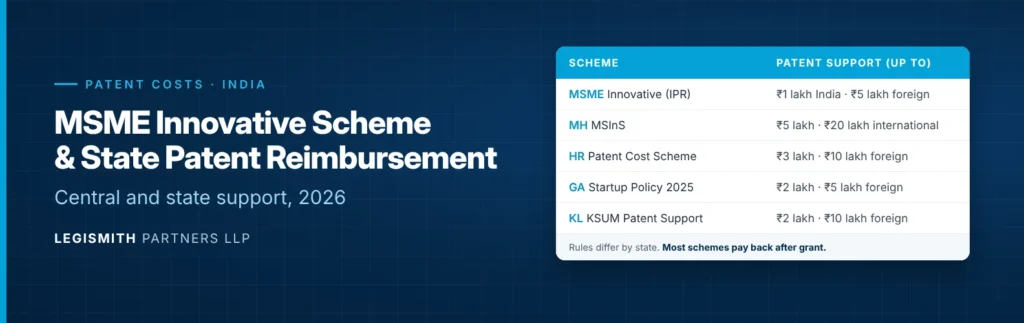
Three central routes help with patent costs. Startups, small entities and individuals pay lower official fees. Manufacturing MSMEs can claim money back under the MSME Innovative Scheme. SIPP, the facilitator scheme for startups, has closed. Many states add their own support, from ₹75,000 for students in Gujarat to ₹20 lakh in Maharashtra.
Central route | What you get | Who can use it | Source |
|---|---|---|---|
Lower official fees (Patents Rules, First Schedule) | You pay less when you file. For example, Form 1 costs ₹1,600 instead of ₹8,000 online. | Natural persons, startups, small entities, educational institutions | |
MSME Innovative Scheme – IPR | Money back after registration, up to fixed limits | Manufacturing MSMEs with Udyam registration | |
SIPP (Startups Intellectual Property Protection) | The government paid the facilitator’s professional fee | Closed: the last term ran three years from 01/04/2023; no extension notified as of 12/11/2026 | |
KAPILA | Patent support for students and educational institutions | Schools and institutions | See our KAPILA scheme guide |
These routes work very differently. A fee concession saves money on the day you file. A reimbursement pays you back months or years later, and only if you claim it correctly. Mixing the two up is behind the “50% patent subsidy” claim that still circulates on forums.
What does the MSME Innovative Scheme reimburse?
The IPR part of the MSME Innovative Scheme pays back registration costs up to fixed limits: ₹5 lakh for a foreign patent, ₹1 lakh for an Indian patent, ₹2 lakh for a GI, ₹15,000 for a design and ₹10,000 for a trademark. The Ministry’s 2025-26 booklet limits this support to manufacturing MSMEs with Udyam registration.
IP right | Maximum reimbursement (as of 10/11/2026) |
|---|---|
Foreign patent | ₹5,00,000 |
Indian patent | ₹1,00,000 |
Geographical Indication (GI) | ₹2,00,000 |
Design registration | ₹15,000 |
Trademark | ₹10,000 |
Source: Ministry of MSME, “Schemes for MSMEs 2025-26”, pages 42–43.
The Ministry describes the scheme as one that “will be an amalgamation of the Incubation, Design and IPR Schemes” (MSME RAMP). That explains a common mix-up. When you search for the scheme, the first figure you see is often ₹15 lakh. That money goes to host institutes to develop ideas. It does not pay your patent bill.
Two points are easy to miss. First, the booklet names manufacturing MSMEs for the IPR part, so a service business should not plan around it. Second, the support is for registration, which means you claim after the patent is granted or the right is registered. Applications run through the MSME Innovative portal.
Is SIPP still available for startups in 2026?
No. SIPP’s last notified term ran for three years from 01/04/2023, and IP India listed no extension when we checked on 12/11/2026. Startups filing now pay their patent agent themselves. The lower official fees for startups are a separate rule and still apply, so that saving remains.
As an empanelled SIPP facilitator, we can confirm the scheme is no longer taking new filings. Those lower fees are now where most startups save money first. Here are the online (e-filing) government fees. Professional fees for drafting and filing are separate and are not shown.
Form (e-filing) | Startup, small entity or individual | Others |
|---|---|---|
Form 1 – patent application | ₹1,600 | ₹8,000 |
Form 18 – request for examination | ₹4,000 | ₹20,000 |
Form 18A – expedited examination | ₹8,000 | ₹60,000 |
TM-A – trademark application (per class) | ₹4,500 | ₹9,000 |
Government fees only, as of 10/11/2026. Sources: IP India patent fee schedule; IP India trademark fees.
Startups can also ask for expedited examination under Rule 24C. Our guide to startup IP benefits explains each one in detail. The patent fee calculator shows the full fee picture for your case.
Not sure which of these applies to your filing? Schedule a call with our team.
Work out official Indian patent fees for your application, based on the First Schedule of the Patents Rules.
Which states reimburse patent costs?
Most states with a startup or MSME policy offer some patent support, but the rules vary widely. Maharashtra pays up to ₹20 lakh for international filings, while Arunachal Pradesh offers ₹10,000 per Indian patent. A few schemes cover trademarks, most do not, and several older policies may no longer be open.
The table uses the same order as our state-wise patent filings article: the states that file the most patents come first.
| State | Scheme | Indian patent | Foreign patent | Trademark / design | Status (10/11/2026) |
|---|---|---|---|---|---|
| Tamil Nadu | MSME Department subsidy for IP | 75% of filing cost, up to ₹3 lakh | Same limit | TM / GI: 50%, up to ₹25,000 (manufacturing MSMEs) | Current |
| Maharashtra | MSInS IPR Support Scheme (Policy 2025) | Up to ₹5 lakh per applicant | Up to ₹20 lakh per applicant | Designs and software copyright; no trademarks | Current |
| Karnataka | Startup Policy 2025-30 | Patent filing cost support (amount in policy annexure) | — | — | Approved 14/11/2025; confirm with KITS |
| Uttar Pradesh | Startup Policy 2026 | 100% of spend up to ₹50 lakh (patents and quality certification), lower rates above | Not split | Not stated | Current |
| Telangana | Innovation Policy (2017, amended 2021) | ₹2 lakh per patent granted | ₹10 lakh | Trademarks and design patents added in 2021 | Confirm with TSIC |
| Delhi | Delhi Startup Policy (2022) | Up to ₹1 lakh | Up to ₹3 lakh | Covers trademarks, copyright and designs | Confirm it is operational |
| Andhra Pradesh | Innovation & Startup Policy 4.0 (2025) | 50%, up to ₹2 lakh | 50%, up to ₹10 lakh | Not covered | Current (filing fees only) |
| Gujarat | SSIP 2.0 (students and institutions) | ₹75,000 | ₹1.5 lakh | TM ₹12,500; design ₹9,000 | Current until 31/03/2027 |
| Haryana | Patent Cost Reimbursement Scheme (2024) | 100%, up to ₹3 lakh | 100%, up to ₹10 lakh (₹25 lakh total) | Not covered | Current |
| Rajasthan | Investment Promotion Scheme 2024 | 75%, up to ₹5 lakh (startups) | Not split | TM / GI matched to central support | Confirm |
| Uttarakhand | Startup Policy 2023 | 100%, up to ₹1 lakh | 100%, up to ₹5 lakh | TM and design ₹10,000 each | Current |
| Kerala | KSUM Patent Support Scheme | Up to ₹2 lakh | Up to ₹10 lakh | Patents only | Current |
| Madhya Pradesh | Startup Policy 2022 | Up to ₹5 lakh | — | Not stated | Confirm |
| Odisha | Startup Policy 2016 / MSME Policy 2022 | 100%, up to ₹10 lakh | — | TM up to ₹3 lakh (MSME policy) | Confirm |
| Chhattisgarh | Startup Package 2024-30 | 50%, up to ₹10 lakh | — | Not stated | Current |
| Bihar | Startup Policy 2022 | Domestic filing costs | Filing fees if granted | Reported to cover TM and designs | Confirm limits |
| Goa | Goa Startup Policy 2025 | 100%, up to ₹2 lakh | 100%, up to ₹5 lakh | TM 50%, up to ₹25,000 | Current |
| Tripura | Start-Up Policy 2024 | ₹2 lakh per patent granted | ₹10 lakh | Not covered | Current |
| Nagaland | Startup Policy 2019 | Up to ₹2 lakh | Up to ₹5 lakh | Not covered | Confirm |
| Manipur | Startup Scheme 2.0 (2022) | Up to ₹2 lakh | Up to ₹5 lakh | Not covered | Confirm |
| Arunachal Pradesh | Startup Policy 2022 | ₹10,000 per patent granted | ₹1 lakh | Not covered | Confirm |
“Confirm” means the official text exists but its period has passed, or the page shows no date. Check with the state’s startup cell before you rely on it.
We could not confirm a current patent scheme for Punjab, West Bengal, Jharkhand or Assam. The same goes for Meghalaya, Mizoram, Sikkim, the Andaman and Nicobar Islands, Ladakh and Lakshadweep. Punjab and Assam have new policies, but their patent terms were not available in official text when we checked. Applicants there can still use the central routes above. If you are in Maharashtra, our MSInS IPR scheme guide covers that scheme in full.
When is the money paid: at filing or after grant?
Mostly after grant. The MSME scheme, Maharashtra, Goa, Haryana and Tamil Nadu pay once the patent is granted or the right is registered. A few states split the payment: Telangana and Tripura pay half at filing, and Uttarakhand pays 75% at filing. In every case, you pay your agent first and claim later.
Scheme | When you can claim |
|---|---|
MSME Innovative Scheme – IPR | After registration or grant |
Maharashtra (MSInS) | Startups: after grant or registration |
Haryana | After grant; claim within 6 months |
Tamil Nadu (MSME) | After registration; claim within 6 months |
Goa | After registration |
Kerala (KSUM) | In three stages: filing, prosecution and grant |
Telangana, Tripura | 50% at filing, 50% at grant |
Uttarakhand | 75% at filing, 25% during prosecution |
Kerala’s scheme puts it plainly: “No advance Payment is considered.” A patent can take years to be granted. So treat any reimbursement as a later refund, not as money for your launch. Deadlines matter too. In Haryana and Tamil Nadu, a claim filed more than six months after grant may be refused.
Can you claim central and state support together?
Yes, in many cases, but never for the same rupee twice. Maharashtra’s scheme, for example, only looks at the part of an expense that another source has not already paid. Take the fee concession first, then claim each scheme for the costs it actually covers, and keep one set of invoices that shows who paid what.
A manufacturing startup in Pune might work through it like this:
- File at the startup or small-entity rate, which lowers the official fees from day one.
- After grant, claim under the MSME Innovative Scheme, since it is a manufacturing MSME.
- Claim the remaining eligible cost under the state scheme, declaring the central amount already received.
Some states are stricter. Chhattisgarh, for instance, does not allow a startup to claim where it has already taken a similar central benefit.
The scheme rules show three ways a claim can fail. The first is eligibility: a service business cannot use the MSME scheme, and Maharashtra caps startup turnover. The second is timing, when a claim comes before grant or after a six-month window closes. The third is paperwork, such as copies instead of original invoices, or no declaration that the cost was not claimed elsewhere.
IP awareness sessions for engineers and technical staff, covering what can be patented, when to file and how to keep records.
Who is eligible: startups, MSMEs, students or individual inventors?
It depends on how you are registered. Manufacturing MSMEs with Udyam registration can use the MSME scheme. DPIIT-recognised startups get the lower fees and qualify for most state startup schemes. Students have a few routes of their own, such as Gujarat’s SSIP. Individual inventors mostly get the lower fee scale only.
You are | Where to look |
|---|---|
A manufacturing MSME (Udyam) | MSME Innovative Scheme – IPR; Tamil Nadu MSME subsidy; lower official fees as a small entity |
A DPIIT-recognised startup | Lower official fees; your state’s startup scheme (see the table above) |
A student or institution | Gujarat SSIP 2.0; Maharashtra MSInS for ITI and skill-university students; Kerala through IEDCs; KAPILA |
An individual inventor | The natural-person fee scale; a few state schemes, so check your state’s rules |
Most state schemes also require you to be registered in that state. Maharashtra, for instance, asks for DPIIT recognition, registration in the state and a turnover limit.
What documents do you need to claim?
Every scheme asks for three kinds of proof: who you are, what you paid, and that the right exists. Keep original invoices and receipts from the start, because they are hard to replace years later when the patent is finally granted.
Most schemes ask for:
- Proof of status, such as your Udyam certificate, DPIIT recognition or state registration.
- Filing receipts, and the grant or registration certificate.
- Original invoices and proof of payment from your patent agent or attorney.
- Bank details for the transfer.
- A self-declaration that the same cost has not been claimed elsewhere.
- Consent or ownership documents if the right is jointly owned.
A patentability search before you file also helps. Schemes pay back filing costs, not the cost of an invention that turns out to be unpatentable.
Frequently Asked Questions
Is there a 50% patent subsidy for MSMEs?
Not as a general rule. The central MSME Innovative Scheme pays back up to ₹1 lakh for an Indian patent and ₹5 lakh for a foreign one. It is open to manufacturing MSMEs. Separately, startups and small entities pay lower official fees. Some states pay 50% or 75% of costs, so check your own state’s rules.
Do these schemes cover trademarks?
Some do. The MSME Innovative Scheme pays up to ₹10,000 per trademark. Tamil Nadu, Telangana, Uttarakhand, Goa and Delhi’s 2022 policy also include trademarks. Maharashtra’s revised MSInS scheme does not. Startups and small enterprises also pay ₹4,500 instead of ₹9,000 per class when they file online.
Does the MSME scheme cover foreign patents?
Yes. The IPR part of the MSME Innovative Scheme allows up to ₹5 lakh for a foreign patent. That is five times the ₹1 lakh limit for an Indian patent. As of 10/11/2026, the Ministry’s 2025-26 booklet limits this support to manufacturing MSMEs with Udyam registration.
Can a student get support for a patent?
Yes, in some states. Gujarat’s SSIP 2.0 supports students and institutions with up to ₹75,000 for an Indian patent. Maharashtra’s MSInS covers current and recent ITI and skill-university students, and Kerala supports students through IEDCs. Schools can look at the KAPILA scheme.
Do I pay first and claim later?
Yes, almost always. Kerala’s scheme states that no advance payment is made, and most others pay against invoices after filing or grant. Plan to fund the full cost yourself, then claim the eligible part with original bills and proof of payment.
What happens if my patent is not granted?
Schemes that pay only after grant, such as Haryana’s and Maharashtra’s scheme for startups, will not pay if the patent is refused. Schemes that pay in stages, like Telangana’s and Uttarakhand’s, may already have paid the filing-stage share. Read your state’s rules before you file.
Preparing Your Filing for a Reimbursement Claim
Government support for patents in India is real, but it rewards people who plan early. Three habits make the difference. Check which schemes you qualify for before you file. Keep every invoice and receipt in one folder. And note each claim deadline, such as six months from grant in Haryana and Tamil Nadu.
If you are weighing a filing, you can schedule a call with our team at Legismith LLP to see which schemes may apply. Startups can read about our startup IP services, and other applicants can see our patent services.
The content provided in this article is for general informational purposes only and does not constitute legal advice. Please consult with a qualified IP attorney for your specific needs.
Talk through the filing process, the documents you need and the timelines with our patent team.