
You have built something new. Perhaps it is a machine part, a chemical formula or a clever piece of software. The first question most inventors ask is simple: what can be patented in India, and does my work qualify?
The answer is not a list. It is a set of tests. Your invention must pass every one of them under the Patents Act, 1970, and it must not fall into any of the excluded categories.
India received 1,10,375 patent applications in 2024–25, according to the IP India Annual Report 2024–25. Many came from first-time filers. At Legismith LLP, we explain below how the law decides what qualifies.
What Can Be Patented in India: The Short Answer
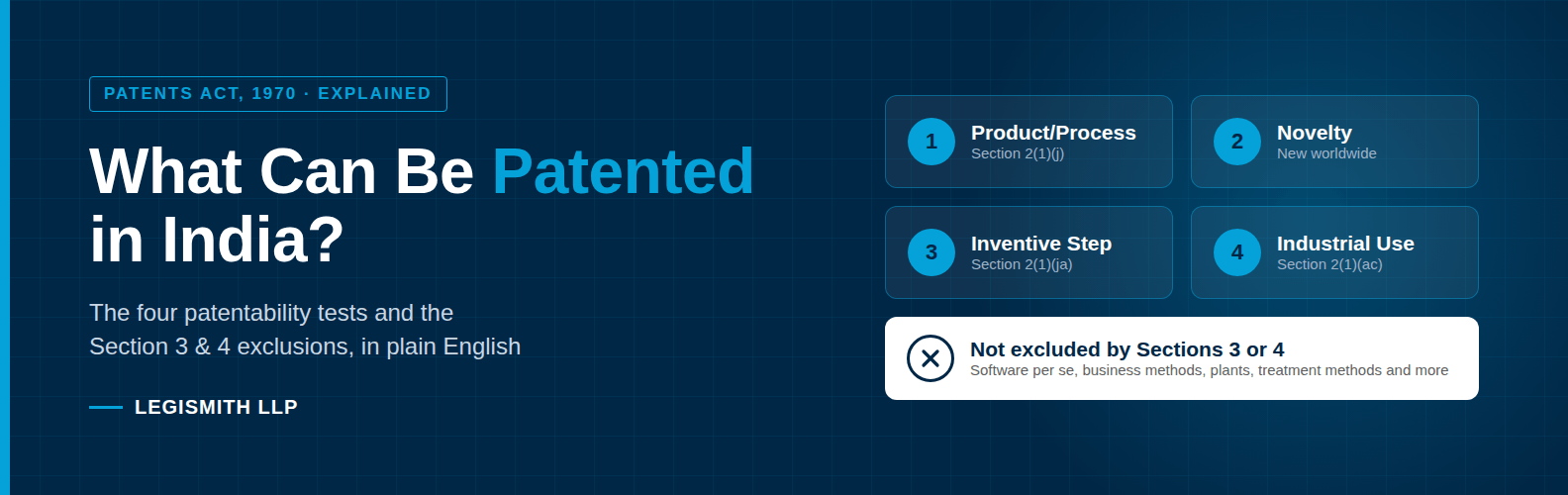
An invention can be patented in India if it meets four conditions:
- It is a product or a process. Section 2(1)(j) covers only these two.
- It is new. It has not been published or used publicly anywhere in the world.
- It involves an inventive step. It is not obvious to a skilled person in that field.
- It is capable of industrial application. It can be made or used in an industry.
On top of this, it must not be excluded by Section 3 or Section 4. You must also describe it clearly enough in your complete specification for an expert to repeat it.
Pune's Trusted IPR Experts.
Speak directly with experienced professionals to navigate complex legal frameworks.
The Four Patentability Criteria in India Explained
1. A product or a process
A patent protects a concrete thing or a concrete method. A bare idea does not qualify. “An app that books auto-rickshaws” is an idea. The specific technical system that makes it work may be an invention.
2. Novelty
Novelty in India is absolute. A journal article in Japan, a YouTube demo or your own LinkedIn post can all destroy it. What matters is whether the invention was disclosed before your filing date.
3. Inventive step
Section 2(1)(ja) requires a technical advance, or economic significance, or both. The invention must also not be obvious to a person skilled in the art. Small, predictable changes to known products usually fail here.
4. Industrial application
Under Section 2(1)(ac), the invention must be capable of being made or used in an industry. Purely theoretical ideas do not pass.
A common myth is that you need a working prototype. You do not. A complete specification that lets a skilled person carry out the invention is enough.
Examples of Patentable Inventions in India
Subject to the four tests, these commonly qualify:
- Machines, tools, devices and apparatus
- Manufacturing and chemical processes
- New chemical compounds and materials
- Pharmaceuticals that show enhanced therapeutic efficacy
- Medical devices and diagnostic kits (though not treatment methods)
- Genetically engineered micro-organisms and biotech processes
- Computer-implemented inventions that show a technical effect
- Genuine technical improvements to existing products
If you are unsure where your work fits, a patentability search report compares it against existing patents and publications before you file.
What Cannot Be Patented in India Under Section 3
Section 3 lists what the law does not treat as an “invention” at all. Here is each clause with a plain example.
Clause | What is excluded | Example |
3(a) | Frivolous inventions, or those contrary to natural laws | A perpetual motion machine |
3(b) | Inventions against public order, morality, health or the environment | A device built for an illegal purpose |
3(c) | Mere discoveries of principles or things occurring in nature | Finding a natural mineral or microbe |
3(d) | New forms or new uses of known substances, without enhanced efficacy | A new crystal form of a known drug |
3(e) | Mere admixtures with only combined properties | Two known medicines mixed, with no synergy |
3(f) | Mere arrangement of known devices working independently | A torch and a radio in one case |
3(h) | Methods of agriculture or horticulture | A crop rotation technique |
3(i) | Medical, surgical and diagnostic treatment methods | A surgical procedure |
3(j) | Plants, animals, seeds and varieties (micro-organisms excepted) | A new wheat variety |
3(k) | Mathematical or business methods, computer programmes per se, algorithms | A pricing formula; source code |
3(l) | Literary, artistic, musical and cinematographic works | A novel or a film |
3(m) | Mental acts or rules for playing a game | Rules of a board game |
3(n) | Presentation of information | A new chart layout |
3(o) | Topography of integrated circuits | A chip layout design |
3(p) | Traditional knowledge | Turmeric for wound healing |
You may notice there is no 3(g). It was removed by the Patents (Amendment) Act, 2002. The full text is available on India Code, the Government’s legislation portal.
Section 4: Atomic Energy and the 2025 Change
For over fifty years, Section 4 barred patents for any invention relating to atomic energy. Many online guides still describe it that way.
In December 2025, Parliament passed the SHANTI Act, 2025, which amends Section 4. It removes the absolute bar. Nuclear-energy inventions may now be patented, subject to the usual tests and conditions set by that Act. Sensitive activities such as enrichment and reprocessing remain restricted.
If your work touches this field, check the current notification status on the official IP India website before you plan a filing.
Can Software and AI Be Patented in India?
This is the question we hear most often. The short answer: software cannot be patented as such, but a software-based invention can be.
The key words in Section 3(k) are “per se”. Code on its own is protected by copyright registration, not patents. But if the invention produces a technical effect or makes a technical contribution, it may qualify. Examples include faster data processing, lower memory use or better control of a machine.
The courts have drawn this line clearly:
- Ferid Allani v. Union of India (Delhi High Court, 12/12/2019) confirmed that inventions with a technical effect are not barred.
- Kroll Information Assurance LLC v. Controller (Delhi High Court, 31/07/2025) upheld a refusal where the system used only generic, conventional computer hardware.
On 29/07/2025, the Patent Office released revised Guidelines for Examination of Computer Related Inventions. They cover AI, machine learning, blockchain and quantum computing, with 60 worked examples. Our article on AI and IP rights in India looks at this area in more depth.
Pharmaceutical, Biotech and Traditional Knowledge Inventions
Medicines and Section 3(d)
A new form of a known drug must show better therapeutic efficacy. In Novartis AG v. Union of India (01/04/2013), the Supreme Court refused a patent for a new crystal form of the cancer drug imatinib on this ground.
Biotechnology and micro-organisms
Plants and animals are excluded, but micro-organisms are not. Engineered micro-organisms and many biotech processes can be patented. If your invention uses biological resources from India, you will also need approval from the National Biodiversity Authority.
Traditional knowledge
India learned this lesson the hard way. A US patent on turmeric for wound healing was revoked in 1997 after CSIR showed the use appeared in ancient texts. India then built the Traditional Knowledge Digital Library, which now holds over five lakh formulations.
Not Patentable? Other Ways to Protect Your Work
An exclusion does not leave you without options. Other rights often fit better.
What you have | Possible protection |
Software code, books, music | Copyright |
Shape or appearance of a product | |
Brand name or logo | |
New plant variety | Registration with the PPV&FR Authority |
Chip layout design | Semiconductor layout-design registration |
Business method or secret formula | Trade secret protection |
Secure Your Patent in India.
Learn about the statutory requirements and process for patent filing. Navigate complex legal frameworks with architectural precision and transparency.
Do Not Disclose Your Invention Before You File
This is where many good inventions are lost. Pitching at a trade fair, publishing a paper or posting a demo video before filing can destroy novelty.
Sections 29 to 34 allow limited grace periods, for example for certain exhibitions and papers read before learned societies. They are narrow and should not be relied on as a plan. If your invention is still developing, a provisional specification can secure your filing date first.
How to Check Whether Your Invention Is Patentable
- Write a clear description of what your invention does and how.
- Search the IP India public patent search and WIPO PATENTSCOPE.
- Check your invention against each Section 3 clause above.
- Ask a registered patent agent for a formal patentability opinion.
If you would like a second view on whether your invention passes these tests, you can reach our patent team for a discussion.
Frequently Asked Questions
Can an idea be patented in India?
No. Only a concrete product or process, described in enough detail for an expert to carry it out, can be patented.
Can a business method be patented in India?
No. Section 3(k) excludes business methods. A technical system that carries out a business function may still qualify if it shows a technical effect.
Can a medical treatment be patented in India?
Treatment methods cannot, under Section 3(i). The medicine or medical device used in the treatment may be patentable.
Can plants or seeds be patented in India?
No. Section 3(j) excludes them. New plant varieties are registered under the Protection of Plant Varieties and Farmers’ Rights Act, 2001.
Do I need a prototype to file a patent?
No. A complete specification that enables a skilled person to carry out the invention is sufficient.
Final Thoughts
Deciding what can be patented in India comes down to four tests and one list of exclusions. Is it a product or process? Is it new? Is it inventive? Can industry use it? And does it avoid Sections 3 and 4?
If the answers look promising, the next step is understanding the filing route. Our guide to patent registration in India walks through each stage, and our patent fee calculator sets out the official fees.
Which of the four tests do you think your invention will find hardest to meet?
Disclaimer
The content provided in this article is for general informational purposes only and does not constitute legal advice. Please consult with a qualified IP attorney for your specific needs.
Protect Your Innovation
Schedule your consultation with our expert IP attorneys to secure your assets and scale your brand globally. Partner with us to build a lasting legacy.