
How to File a Trademark Under the Madrid Protocol?
Overview
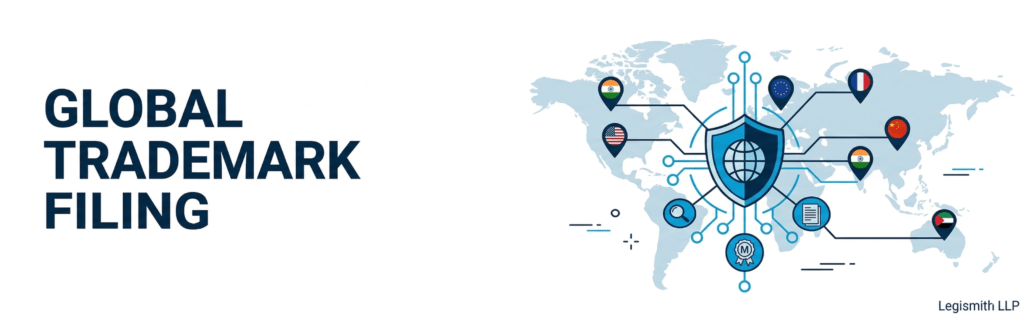
Expanding your brand internationally requires more than just a domestic trademark. If you plan to operate in multiple countries, filing separate applications in each jurisdiction can be complex and costly. The Madrid Protocol simplifies this process by allowing you to file a single international trademark application covering multiple countries.
At Legismith LLP, we often guide applicants who want a structured and efficient way to secure global trademark protection. This article explains how to file a trademark under the Madrid Protocol, along with eligibility, costs, and key procedural steps.
Before proceeding internationally, it is important to understand the domestic foundation, as explained in our guide on “Trademark Registration in India“.
What is the Madrid Protocol?
The Madrid Protocol is an international treaty administered by the World Intellectual Property Organization (WIPO). It enables trademark owners to seek protection in multiple countries through a single application.
Instead of filing separate applications in each country, you can file one international application through your home country’s trademark office. This application is then examined by WIPO and forwarded to the selected countries.
India joined the Madrid Protocol on 08/07/2013, and the relevant provisions are incorporated under Chapter IV-A (Sections 36A–36G) of the Trade Marks Act, 1999.
Who Can Use the Madrid Protocol?
You can use the Madrid Protocol if you have a connection with a member country. This includes:
- Being a citizen of a member country
- Having a business establishment in a member country
- Being domiciled in a member country
For Indian applicants, you must first have a basic trademark application or registration in India. This is called the “basic mark” and forms the foundation of your international application.
Madrid Protocol Member Countries
The Madrid System continues to expand globally. As of 2026, it covers over 132 countries, representing a significant portion of global trade.
A recent development includes Grenada joining the Madrid System, with the Protocol entering into force there on 15/03/2026. This expansion strengthens the system’s global reach and makes it more useful for businesses seeking international protection.
Madrid Protocol for International Trademark Registration
The Madrid Protocol provides a centralised system for international trademark registration. Some key features include:
- One application for multiple countries
- One language (English, French, or Spanish)
- One set of fees (paid to WIPO in Swiss Francs)
- Centralised management of renewals and changes
If you are exploring global filing, you may also read our step-by-step guide to understand how Madrid fits within broader international trademark strategies.
An international registration under the Madrid Protocol is not a single global trademark. Instead, it acts as a bundle of national rights, where each designated country examines the application under its own laws.
How Does the Madrid Protocol Work?
The system operates in three main stages:
1. Filing Through the Office of Origin
You file your international application through your home trademark office (in India, this is the Trade Marks Registry).
2. Examination by WIPO
WIPO checks formalities such as classification, documentation, and fee payment. If compliant, the mark is published in the International Trademark Gazette.
3. Examination by Designated Countries
Each selected country examines the application according to its national laws. They may:
- Accept the mark
- Raise objections
- Issue refusal or allow opposition
If no refusal is issued within the prescribed time (usually 12–18 months), protection is granted in that country.
How to File Madrid Protocol Application
Filing an international trademark under the Madrid Protocol involves the following steps:
Step 1: File a Basic Trademark in India
You must first file or obtain a trademark in India. You can refer to our guide for detailed steps.
Step 2: Prepare International Application (MM2 Form)
The international application must include:
- Details of the applicant
- Representation of the mark
- List of goods/services (aligned with the basic application)
- Designated countries
Step 3: Submit Through IP India
You must file the application via the Indian Trademark Office using the official portal.
The Indian office verifies and certifies the application before forwarding it to WIPO.
Step 4: WIPO Examination and Publication
WIPO examines the application and publishes it in the International Register.
Step 5: National Examination by Designated Countries
Each country reviews the application independently and may raise objections or grant protection.
How Much Does the Madrid Protocol Cost?
The cost of filing under the Madrid Protocol includes:
- Basic fee (paid to WIPO)
- Additional fees for each designated country
- Individual fees depending on the country
The basic fee starts at approximately CHF 653, excluding country-specific charges.
One important aspect is that you pay a single consolidated fee to WIPO in Swiss Francs, rather than paying separate fees in each country’s currency. This simplifies the payment process significantly.
Madrid Protocol Fee Calculator
To estimate the exact cost of your application, you can use the official WIPO fee calculator.
This tool helps you calculate fees based on the number of countries and classes selected.
Madrid Protocol Fee Calculator
WIPO provides an online platform called eMadrid, which helps applicants manage their international trademark applications.
You can access it here.
Using this platform, you can:
- File and track applications
- Manage renewals
- Record changes in ownership or details
- Monitor application status
Madrid Protocol Fee Calculator
The Madrid Protocol offers several advantages for international trademark protection:
Simplified Filing
You can file one application instead of multiple national applications.
Cost Efficiency
It reduces administrative and translation costs compared to separate filings.
Centralised Management
Changes such as ownership, address, or renewal can be managed through a single system.
Flexibility
You can add more countries later through “subsequent designation”.
Long-Term Protection
The trademark is valid for 10 years and can be renewed indefinitely.
However, you should also be aware of the central attack risk, where cancellation of the basic mark within five years can affect the entire international registration.
FAQs
1. Can I file directly with WIPO?
No. You must file through your home trademark office (Office of Origin).
2. What happens if one country rejects the application?
Rejection in one country does not affect others. Protection can still be granted in remaining countries.
3. Is prior registration in India mandatory?
You must have at least a filed application (basic mark) in India before applying internationally.
4. How long is the trademark valid?
International registration is valid for 10 years and can be renewed indefinitely.
5. Is rejection common under the Madrid Protocol?
Rejection typically occurs at the national level based on local laws, not at the WIPO stage.
Final Thoughts
Filing a trademark under the Madrid Protocol is a practical option if you are planning international expansion. It reduces complexity, centralises management, and offers flexibility in protecting your brand across multiple jurisdictions.
However, the system requires careful planning, especially because your international registration depends on your basic Indian application for the first five years. Understanding the process, costs, and risks is essential before proceeding.
If you are considering global trademark protection, how many countries are you planning to cover in your initial application?
Register Your Trademark Globally.
Explore the Madrid Protocol for international brand protection. Our counsel simplifies complex cross-border filing into a single, unified strategy.
view fee schedule
Disclaimer
The content provided in this article is for general informational purposes only and does not constitute legal advice. Please consult with a qualified IP attorney for your specific needs.